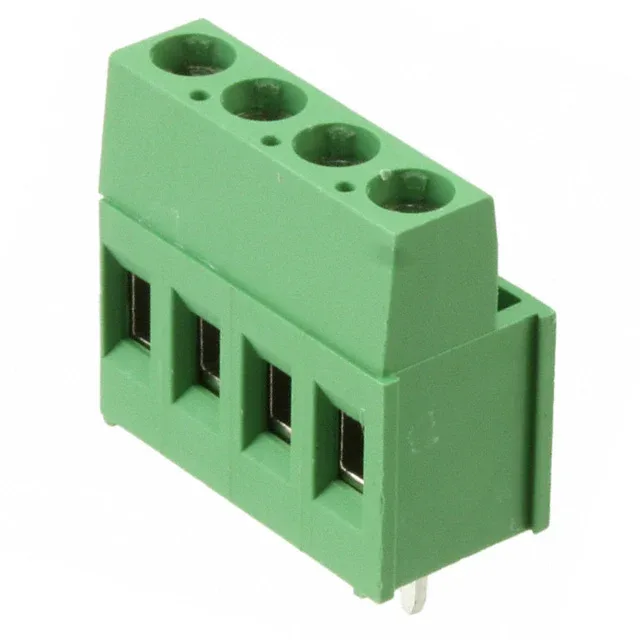
The 282857-4: It uses a screw-driven rising cage clamp to terminate wires from 12 AWG to 30 AWG, with the wire entering parallel to the board surface — a horizontal orientation that keeps the assembly low-profile in enclosures where vertical headroom is tight. Side interlocking tabs let you snap multiple blocks together into a longer terminal strip without needing a separate jumper bar.
Termination and Torque — What the Screw-Clamp Spec Means
The rising cage clamp pulls a brass, nickel-plated clamp plate up against the wire as the M3 screw is tightened. The specified torque of 0.79 Nm (7.0 Lb-In) is the target for a gas-tight connection on solid or stranded wire — under-torquing risks high contact resistance and thermal runaway at 24 A, while over-torquing can strip the PA66 threads or deform the conductor. The contact material is brass with tin plating, which is adequate for the rated current in dry indoor environments; for corrosive atmospheres, a gold-plated contact variant would be preferred, but this block is not offered with that option. The wire strip length and ferrule use (if stranded) follow standard IEC 60947-7-1 practice for cage-clamp terminations.