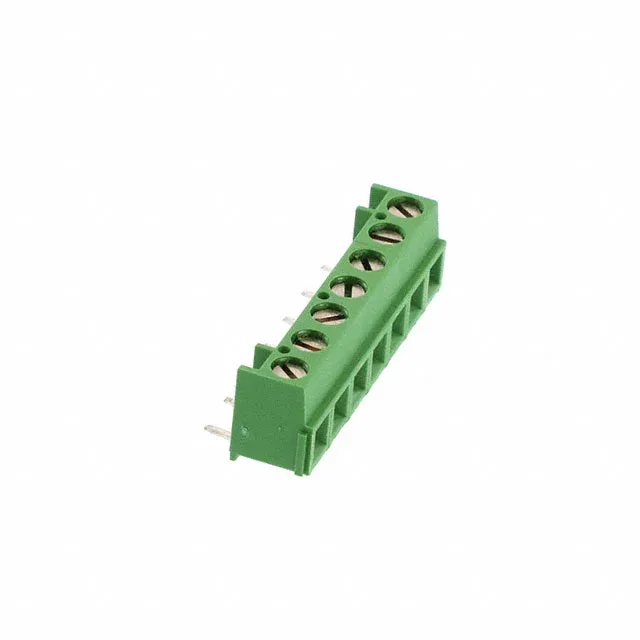
What This 7-Position Buchanan Terminal Block Does on the Board
The TE Connectivity Buchanan 284094-7 is a 7-position, single-level PCB-mount terminal block from the Buchanan series. It terminates wires via a rising cage clamp — turning the M3 screw pulls the clamp up against the conductor, not the screw tip, so the wire is captured evenly across its cross-section. Rated 13.5 A per position at 300 V, this block handles moderate-power distribution on a PCB — think industrial controller outputs, HVAC relay panels, or power supply terminal strips. The green polyamide housing carries a UL94 V-0 rating (implied by the PA66 material grade typical of Buchanan blocks), and the side interlocking feature lets you snap multiple blocks together into a longer strip without needing a separate jumper bar.
Wire Termination and Torque — What the Rising Cage Clamp Needs
The 284094-7 uses a screw-actuated rising cage clamp. The M3 screw takes a specified torque of 0.68 Nm (6 Lb-In) — that's the sweet spot where the clamp grips the conductor without stripping the brass threads or cracking the PA66 housing. Under-torque it and the wire can pull out under vibration; over-torque it and you risk thread damage on the brass-nickel screw. The clamp and screw are both brass with nickel plating, which resists corrosion in panel environments. The contact pad on the PCB side is brass with tin plating — tin is fine for the few insertion cycles a terminal block sees, and it avoids the galvanic mismatch that gold can create with tin-plated board traces. Wire range is 16-30 AWG; solid or stranded both work, but ferruled stranded wire seats more consistently in the cage.
Side Interlocking and Ganging Multiple Blocks
The side interlocking feature lets you snap this block together with adjacent Buchanan blocks of the same pitch to build a multi-position strip. The mechanical key on the side aligns the housings and keeps the row straight.
Mounting Orientation and PCB Layout Notes
This block mates with the wire entry on top (vertical with board orientation). The pins exit the bottom of the housing and go through-hole into the PCB.