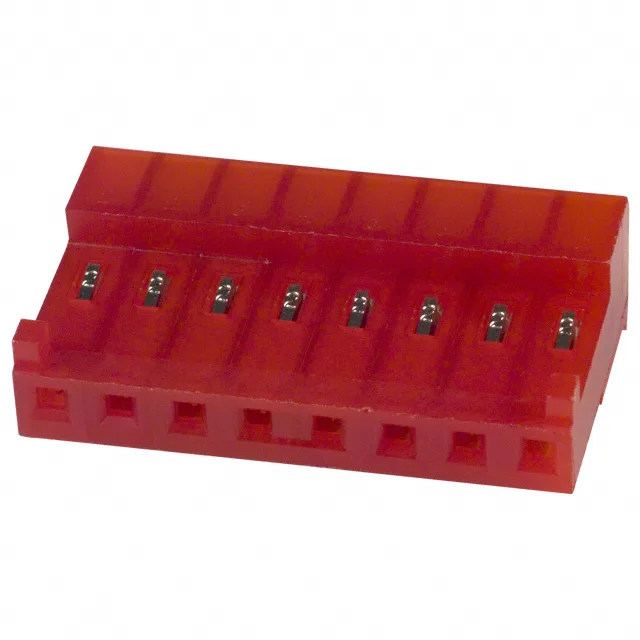
It accepts 22 AWG wire only, so if your BOM calls for 18 AWG, this isn't the one. The closed end and polarizing key mean you can't accidentally reverse the connector in its mating header — a detail that saves a rework when the harness is already taped up.
Why the IDC Termination and 22 AWG Limit Matter on the Bench
IDC termination means no crimp tool, no loose terminals to feed — you lay the ribbon cable or discrete wires into the slot and press. The trade-off is wire gauge: the 3-644463-8 is specced for 22 AWG only. Trying to stuff 18 AWG into the IDC slot risks damaging the contact beam or getting an intermittent connection that shows up weeks later as a field failure. If your application sees frequent disconnect-reconnect cycles, you'd want gold-plated contacts from a different MTA-156 variant.
The 1-1703095-1 is the same MTA-156 family — same IDC termination, same free-hanging mount — but a 4-position receptacle on a 0.197" (5.00mm) pitch, not the 0.156" (3.96mm) of the 3-644463-8. That pitch difference means the 1-1703095-1 is physically wider per contact and uses a latch lock instead of the polarizing key. If your board layout is already set for 0.156" pitch headers, the 1-1703095-1 won't fit without a new footprint. The 8-position count of the 3-644463-8 matches a standard 8-circuit BOM line; the 4-position peer is for smaller harness drops.