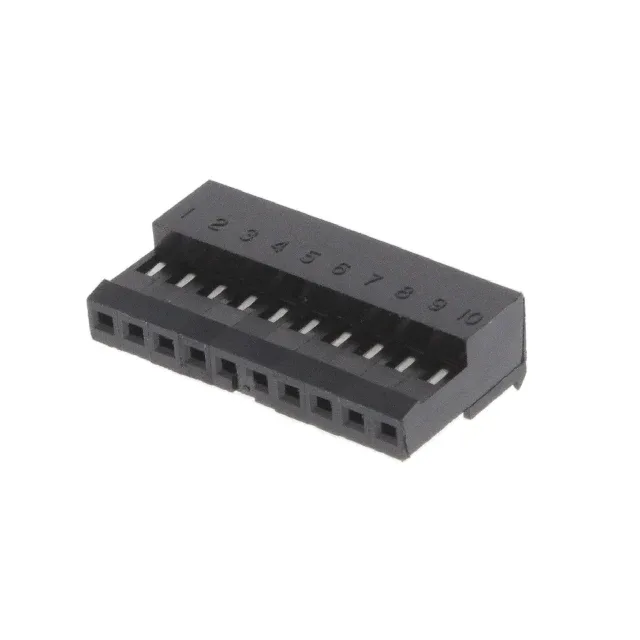
It terminates 22 AWG discrete or ribbon cable directly via insulation displacement, no stripping or crimping required. The 0.100" (2.54mm) pitch matches the standard MTA-100 header footprint, and the single-row layout keeps the connector narrow for tight harness routing. The closed-end feature blocks the last position, making this a terminating connector for the end of a daisy-chain run — it does not pass through to another receptacle.
Termination and Wire Prep — What 22 AWG IDC Means on the Bench
IDC termination for 22 AWG is the defining wiring constraint here. The contacts slice through the insulation and grip the conductor without a separate crimp operation, which saves assembly time but demands consistent wire OD and insulation type. The free-hanging (in-line) and right-angle mounting options let the harness designer route the cable parallel or perpendicular to the header axis without a separate adapter. For a right-angle exit, the cable bends 90° at the connector face — factor that into the bend radius budget for the harness.
Mating and Retention — Locking Ramp vs Header Latch
The ramp is polarized; it only engages one way, so reverse-mating is mechanically blocked. Because the locking ramp is the sole retention mechanism, the mated pair relies on the header's board-mount strength for shear load. In high-vibration applications, a secondary strain relief on the cable side is worth considering — the ramp holds the connector together, not the cable to the contacts.
Lifecycle and Sourcing — Active Production, No LTB Surprises
No official successor or cross-reference part has been issued; the MTA-100 series remains current.