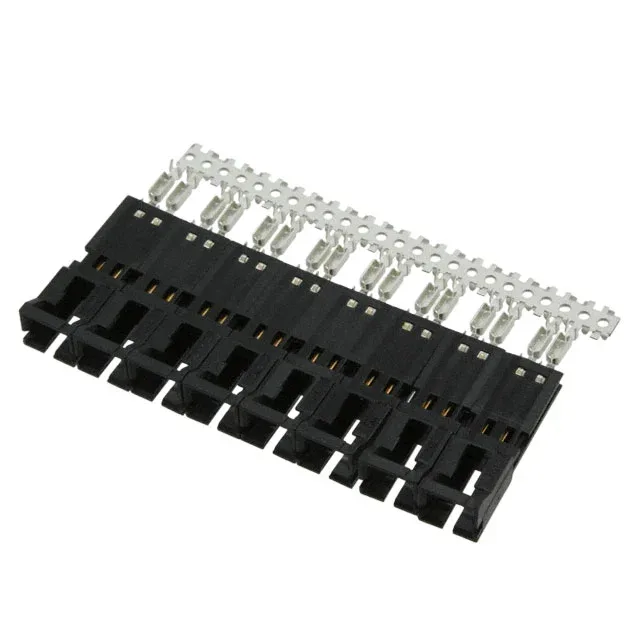
The closed-end housing prevents the cable from pushing through, and the black colour aids visual identification on the assembly bench. This is the smallest position count in the MTE IDC line, used for terminating a single signal pair or a power/ground pair where you need a discrete, field-serviceable connection.
The MTE series uses a detent-lock or latch-lock system depending on the receptacle variant — the plug itself does not carry a locking latch, so the retention force comes from the interference fit of the IDC terminals and the friction of the pin-and-socket interface. For applications where vibration resistance matters, pair it with a receptacle that has an integral latch (check the specific receptacle part number for locking features).
Termination and wire preparation
Termination is IDC — the contacts are pre-loaded into the housing, and the ribbon cable is pressed onto the slot array with a bench press or hand tool. The wire gauge range of 26-30 AWG covers standard ribbon cable gauges; the 30.0µin (0.76µm) gold plating on the male pins gives a corrosion-resistant mating surface that handles repeated connect-disconnect cycles better than tin, though the IDC interface itself is a one-time termination. The closed-end feature means the cable stops at the back wall of the housing, so you don't need to measure cable insertion depth — just press until the cable bottoms out. No strain relief is built into the plug body; for a cable that will be flexed, add a separate strain-relief boot or tie-down point near the connector.