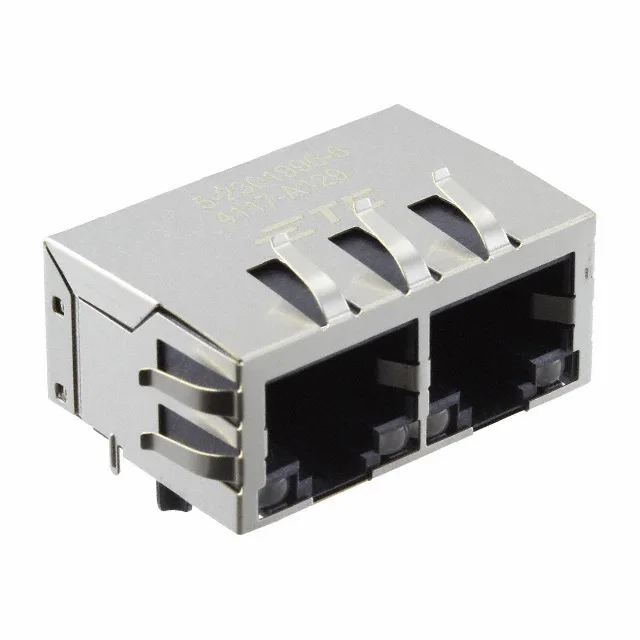
What This 2-Port RJ45 Jack Is Built For
The TE Connectivity 5-2301996-6 is a 2-port RJ45 jack designed for 10/100 Base-T Ethernet applications, with AutoMDIX support. It sits in the 2301996 series and is a shielded, right-angle, through-hole part — the kind you see on industrial Ethernet switches, PLC I/O modules, and telecom line cards where the board edge meets a patch cable. Each port carries four cores, and the connector is built around a single-row layout. The gold-plated contacts (30.0µin over copper alloy) and the shielded body with EMI fingers mean this jack is meant for a controlled signal path, not just a mechanical plug-in. The board lock feature adds mechanical retention during reflow and against cable strain after assembly.
Board Fit and Mechanical Anchoring
At 0.531" (13.49mm) above the board, this is a standard-height RJ45 jack — it clears most enclosures and bezels without a low-profile requirement. For a 2-port jack, that matters — the insertion and extraction force of two cables can shear unanchored SMT pads over time. The through-hole mounting also gives a stronger mechanical bond than a pure SMT part for this size of connector.
Shielding and Signal Integrity for 10/100 Base-T
The brass shield with EMI fingers is the key feature for passing radiated emissions testing in a 10/100 Base-T design. The fingers contact the panel or chassis ground before the signal pins engage, bleeding common-mode noise. This is standard for industrial Ethernet where the cable run is inside a cabinet with motor drives or switching power supplies. The 10/100 Base-T and AutoMDIX rating means the magnetics and PHY on the board handle the signal shaping — the connector itself is a straight-through 1:1 pinout for the four core pairs. It is not rated for Gigabit Ethernet (1000 Base-T), which would require additional shielding and tighter impedance control through the jack.
It ships in a tray, which is typical for through-hole connectors of this size. For a pick-and-place line, the tray format means manual or tube-fed placement — not reel-fed. Plan the assembly process accordingly.