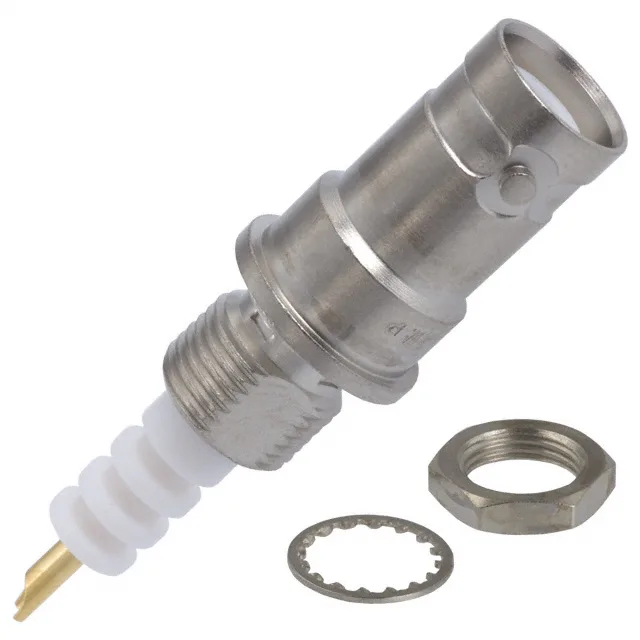
The TE Connectivity 51494-1 is a panel-mount SHV jack from the Coaxicon series, designed for high-voltage coaxial interconnects where a standard BNC or N type would arc over. SHV stands for Safe High Voltage — the interface extends the center pin recess depth and adds creepage distance so the connector handles 5000 V without flashover between center and shell. This is a jack with a male center pin, which mates with an SHV female plug (the center socket on the cable side). Typical homes for this connector: high-voltage power supplies, particle detector bias feeds, pulsed-power test gear, and lab instrumentation where 5 kV needs to pass through a coax line without corona discharge.
5000 V Rating — The Reason This Connector Exists
The 5000 V rating is the defining spec. The SHV interface extends the PTFE dielectric shoulder and recesses the center contact for a longer creepage path.
Cable Fit — RG-59 and RG-62
The 51494-1 is listed for cable group RG-59 and RG-62. RG-59 is the standard 75-ohm video coax; RG-62 is 93-ohm used in legacy IBM terminal and some data acquisition runs. The solder cup termination on the center contact and the solder shield termination on the body mean you tin the center conductor and the braid, then solder directly — no crimp tool needed. The connector ships as three pieces: the body assembly, a lockwasher, and the mounting nut. The extended insulation feature refers to the PTFE bushing that protrudes past the mating face, adding the creepage distance for the 5 kV rating.
Mating Cycles and Build Quality
Rated for 500 mating cycles. That is a solid number for a bayonet-lock connector — the gold center contact plating keeps the mating surface from galling over repeated connects and disconnects in a test rack or lab setup. The center contact is a male pin, so the cable-side plug carries the female socket, which is the more fragile half — the panel jack sees the wear on the pin, which is replaceable as part of the connector assembly. The non-constant impedance means this is not a controlled-impedance RF path; it is a high-voltage DC or low-frequency AC interconnect. For signal integrity above a few MHz, the impedance discontinuity matters — stay below 1 MHz and the 5000 V rating is the only thing that counts.