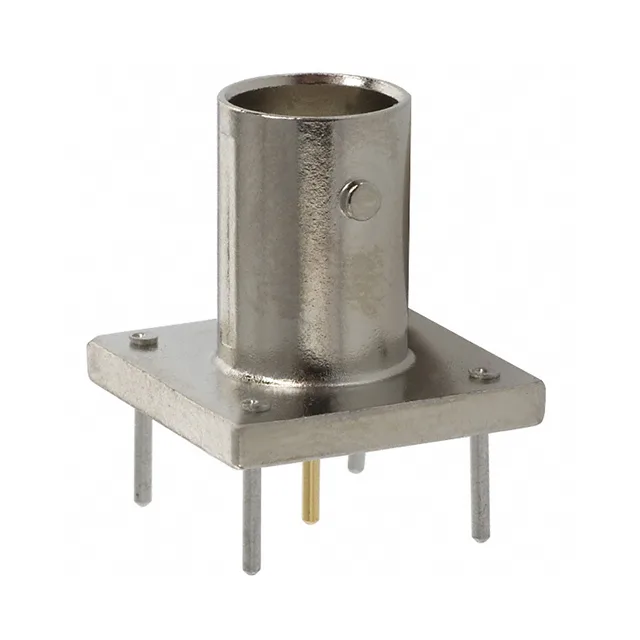
It's a single-port connector rated to 4 GHz, which puts it at the upper end of what a standard BNC interface can handle cleanly. The centre contact is gold-plated phosphor bronze, the body is nickel-plated zinc, and the dielectric is PBT/polyester. This is the kind of RF interconnect you'd see on test equipment, instrumentation backplanes, or RF distribution panels where the signal path needs to stay at 50 Ohms through the board transition.
At 50 Ohms nominal, this jack is a transmission-line component — the impedance match through the solder termination and the PCB trace is what determines the return loss. The 4 GHz frequency ceiling is the practical limit for this BNC interface; above that, the bayonet coupling and the dielectric losses start to degrade the VSWR. The through-hole mount gives a mechanically robust solder joint compared to an SMT RF connector, which matters when the cable is being plugged and unplugged repeatedly. The nickel body finish and zinc housing are standard for a commercial-grade BNC — it's not a corrosion-proof marine or outdoor connector, but it's fine for indoor equipment racks and lab environments.
The 415420-1 and 415218-1 are also active TE parts, but they carry no RF specs in the record — they're listed as bulk-packaged connectors without impedance or frequency data, which suggests they're not RF-grade BNCs. The 5227699-2 is the one with the published 50-Ohm impedance and 4 GHz rating, so it's the correct choice when the signal integrity matters.