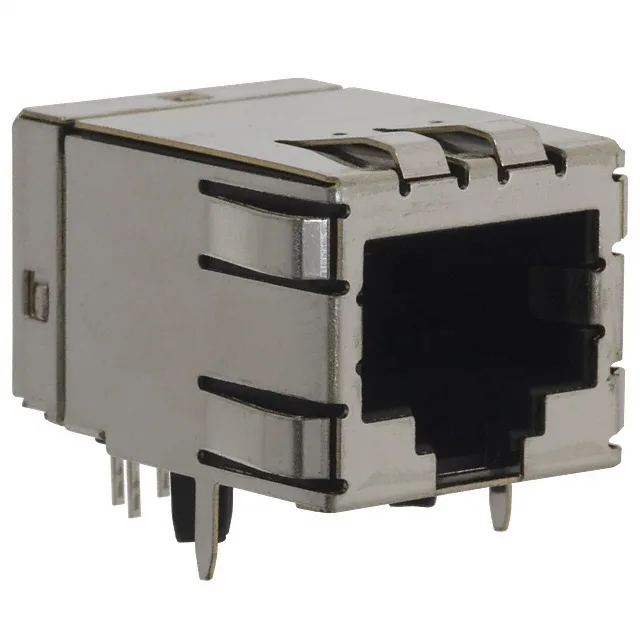
TE 5406296-1: Shielded Cat5 RJ45 Jack for Board-Mount Ethernet
What the Cat5 Rating and Shielding Mean for Signal Integrity
The Cat5 rating on this jack means it's characterised for 100 MHz operation — sufficient for 100BASE-TX and 1000BASE-T (Gigabit Ethernet over short links) in a controlled environment. What the rating doesn't say is that the EMI finger shield is the part that actually makes the link reliable in a noisy box. The fingers contact the panel cutout or chassis ground before the signal pins engage, shunting ESD and coupled noise away from the transformer. If your board layout has the jack near a heatsink fan header or a DC-DC converter, the shielded shell with EMI fingers is the difference between a link that trains at power-up and one that drops packets under load.
This is a right-angle (90°) through-hole solder jack, tab direction down. The through-hole tails give a stronger mechanical anchor than an SMT version would — important when the cable is tugged or the jack is in a panel-mount application where the PCB carries the strain. The single-row 8p8c contact layout matches the standard RJ45 footprint; the board guide posts on the housing locate the part during wave solder and take some shear off the solder joints when the cable is dressed. Tray packaging means the jacks are aligned in a single orientation for pick-and-place or hand-loading — no tape-and-reel feeding issues with a right-angle part that wants to tip.
The tray packaging means the unit cost scales with tray quantity; a blanket order covering several trays typically improves the per-unit price.