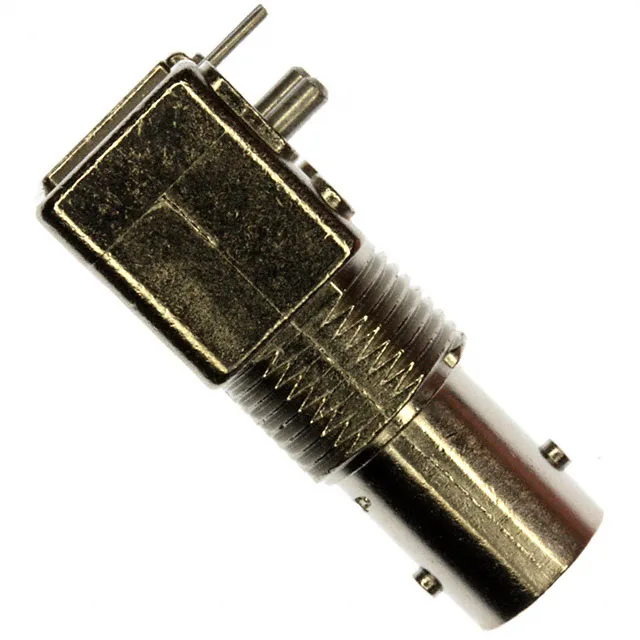
It's the 75 Ohm member of TE's standard BNC family, built for video, telecom, and test equipment where the impedance match matters more than the raw frequency ceiling. The bayonet lock gives a quarter-turn mate that holds without tools, and the bulkhead front-side nut secures it to the panel while the through-hole solder tails tie into the board. Rated to 2 GHz with a 75 Ohm characteristic impedance, this jack is the right choice for composite video, SDI, and legacy telecom distribution — not the 50 Ohm world of RF test gear and cellular. The 500 V rating is comfortable for the signal levels these runs carry; the real limit is the impedance-controlled path through the connector body.
Three attachment points in one connector: the front-side nut clamps the bulkhead, the right-angle solder tails fix to the PCB, and the shield termination is a solder bucket. That means the connector takes mechanical strain off the board — the panel carries the cable weight, not the solder joints. The through-hole tails are tin-plated for soldering; the centre contact is gold-plated beryllium copper, good for the 500 mating cycles the connector is rated to.
Zinc body with nickel finish — standard for BNCs that see indoor rack or cabinet duty.
75 Ohm vs 50 Ohm BNC — what changes
A 50 Ohm plug will physically mate with this 75 Ohm jack, but the impedance mismatch at the interface will cause a reflection — measurable return loss that degrades signal quality above a few MHz. For video and broadcast, the 75 Ohm path is the standard; for RF test and telecom, stay with 50 Ohm. The 5414907-1 is built for the 75 Ohm side of the line.