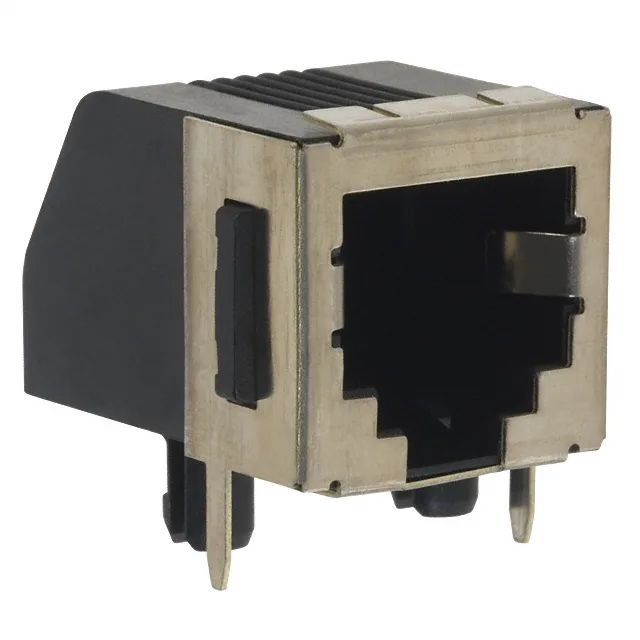
6P4C Jack for Voice-Grade Telecom
The TE Connectivity 5555154-2 is a right-angle, shielded modular jack with a 6p4c contact arrangement — that's six positions, four wired contacts, matching the RJ11 and RJ14 wiring schemes used in single- and dual-line telephone circuits. This is a Cat3-rated connector, which means its transmission performance is specified up to 16 MHz — adequate for analog voice, basic-rate ISDN, and 10BASE-T Ethernet, but not for the 100 MHz bandwidth Cat5 or higher data protocols demand. The shield reduces radiated emissions in electrically noisy environments like industrial control cabinets or central office equipment. The through-hole solder termination and right-angle orientation place the jack parallel to the PCB, letting the cable exit along the board edge. Board locks and panel stops on the housing anchor the connector against the insertion and withdrawal forces of repeated cable mates — the stops register the jack flush against the panel cutout, and the locks hold it during wave solder before the panel screws are torqued.
Cat3 Rating and the Data-Speed Ceiling
The Cat3 rating is the defining performance limit on this jack. Cat3 connectors are tested for attenuation and crosstalk up to 16 MHz, which covers voice and 10BASE-T but blocks any plan to run Gigabit Ethernet or PoE+ data through this port. If the BOM calls for a connector that passes Cat5e or higher, the 5555154-2 is not the right pick — the unshielded 5555154-1 sibling shares the same 6p4c layout and board footprint but lacks the shield, so neither crosses the Cat3 ceiling. The shield here exists for EMI containment, not for data-rate headroom.
Board Locks and Panel Stops for Mechanical Retention
The panel stops are molded standoffs on the jack body that contact the edge of the panel cutout, setting the z-height of the jack face relative to the panel.