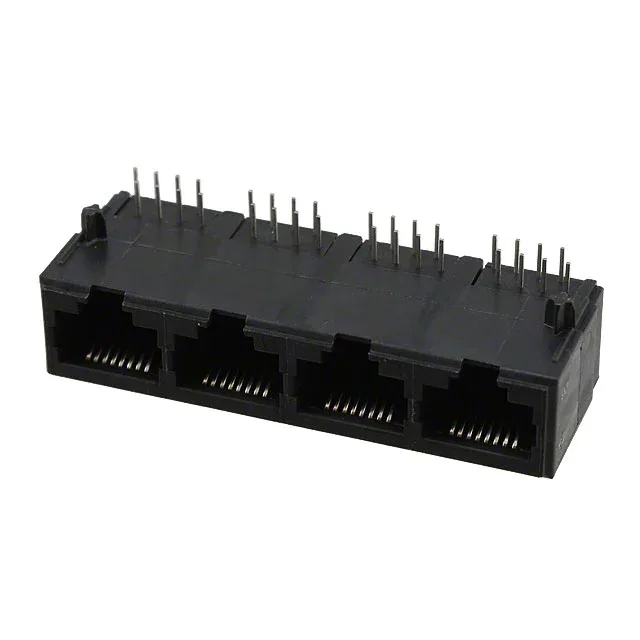
The right-angle orientation (90°) and through-hole mounting suit it for board-edge installation, with the cable exiting parallel to the PCB — typical for networking switches, routers, patch panels, and industrial control interfaces. Each of the four ports shares a single housing, reducing component count and board footprint compared to using four separate jacks.
The 4-port density is the main layout advantage: one part replaces four single jacks, saving placement time and PCB real estate. The unshielded design means there is no metal shell to ground — plan for system-level EMI countermeasures if the application is in a noisy electrical environment. The Cat4 rating indicates the jack meets the electrical performance requirements for Category 4 cabling (up to 20 MHz), sufficient for legacy 10BASE-T and 100BASE-T4 networks, but not for modern Gigabit Ethernet or PoE — verify the cable plant and data rate before specifying.