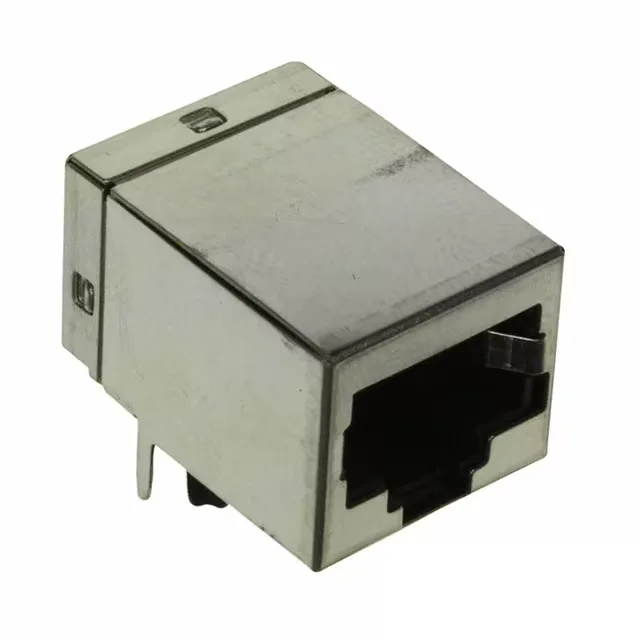
It belongs to the 5557786 base series and carries a Cat3 performance rating, meaning it is specified for voice and low-speed data signaling up to 16 MHz — a ceiling that suits basic Ethernet (10BASE-T) and telephone applications rather than high-throughput networks. The shielded shell and board guide features help manage EMI and simplify alignment during PCB assembly.
The housing is molded from PCT (Polycyclohexylenedimethylene Terephthalate), a high-temperature thermoplastic that withstands lead-free reflow profiles without distortion.
Shielded vs Unshielded — Why It Matters Here
The 5557786-1 is a shielded jack. The practical difference from an unshielded version (like a standard plastic-body RJ45) is that the metal shell provides a low-impedance path to ground for coupled interference. In a Cat3 signal environment — typically voice or 10BASE-T — the noise margin is already tight, so the shielding helps maintain signal integrity over longer cable runs or in electrically noisy racks. The trade-off is that the shield must be properly grounded through the PCB; a floating shield can act as an antenna and worsen emissions.