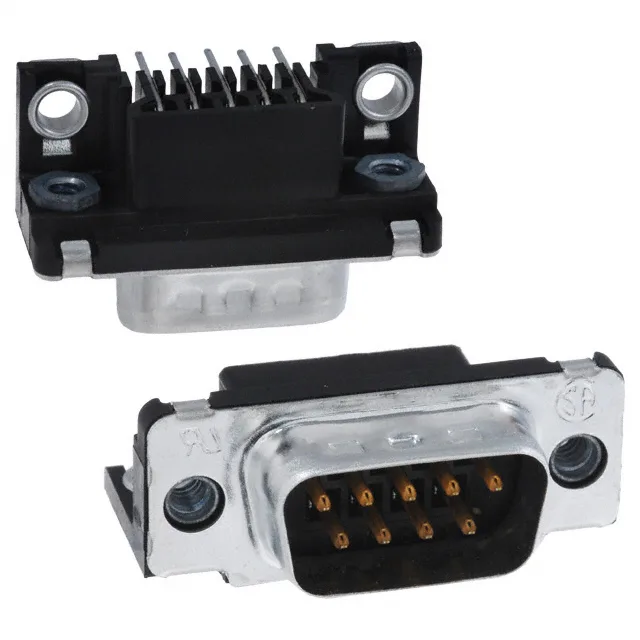
It carries 6A per contact at 125V, with gold flash plating on the brass signal contacts. The steel shell is tin-plated and includes a ground strap and grounding indents for EMI bleed before the signal pins engage. The shell size is DE-1 (E), the standard layout for a 9-pin D-sub. This is the male plug half of a standard-density DE-9 interconnect, typically used for RS-232 serial ports, industrial control interfaces, and instrumentation cabling where a reliable, field-serviceable connector is needed.
The flange has 4-40 threaded inserts for the mating jackscrews, which pull the pair together and resist vibration. The backset spacing of 0.318" (8.08mm) sets the distance from the PCB to the front of the shell — check this against your enclosure cutout and panel thickness before layout.
Grounding and EMI Performance
The ground strap and grounding indents are not universal on basic D-subs. The indents in the shell mate with the receptacle's shell to create a low-impedance ground path before the signal pins touch, which bleeds shield current and reduces EMI coupling. The tin-plated steel shell provides magnetic shielding, which is relevant for industrial environments with motor drives or switching power supplies nearby. For a standard-density 9-pin plug, these features push it above a commodity part for applications where ground integrity matters.
The gold flash (contact finish thickness: Flash) on the brass contacts is the entry-level gold plating. It provides corrosion resistance and low contact resistance for the first several hundred mating cycles, but it will wear through faster than the 15 or 30 microinch gold used on high-cycle D-subs. For a connector that gets mated and unmated a few times during installation and then stays connected, this is fine. For a field-service connector that sees frequent reconnects, consider a version with thicker gold.