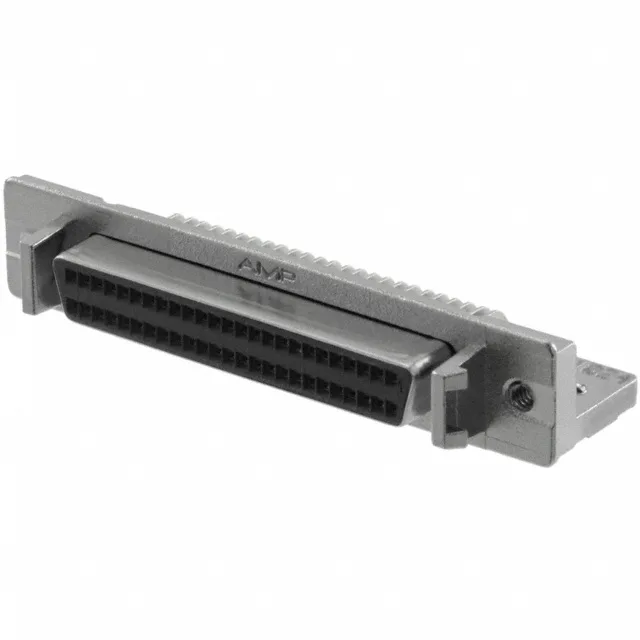
50-Position Shielded D-Sub for Signal-Dense Board-Edge Interfaces
The 5787394-5 is a 50-position D-sub receptacle from the TE AMPLIMITE.050 III series, built for high-density signal interconnects where board-edge real estate is tight. It carries 50 female contacts in a dual-row layout on a 0.050 pitch x 0.100 row-to-row grid — the fine pitch packs more signals per inch than a standard-density D-sub, but the 1 A per-contact rating and 30 V voltage limit mean this is strictly a signal path, not a power rail. A full metal shell — steel with nickel plating — wraps the contact cavity and provides the shielding that makes this connector suitable for EMI-sensitive environments. The shell also carries the flange features with 2-56 threaded inserts and latchblocks, so the mating plug locks in place without relying on the signal pins for mechanical retention.
Pitch, Positions, and the Signal-Density Tradeoff
The 0.050 pitch x 0.100 row-to-row layout is the defining footprint spec for this connector. It is tighter than the 0.090 row spacing on a standard DB-25, which means the PCB layout needs a finer trace-and-space capability to route all 50 signals out from under the connector body. The 50 positions are the full complement for this shell size in the AMPLIMITE.050 III series — there is no higher-density variant in the same shell. If the BOM calls for 50 signal lines, this is the correct position count; a 26-position or 36-position sibling uses a smaller shell and a different board footprint. Compared to the 3-1393480-8, which shares the same series and position count but ships in a box rather than a tube, the functional specs — pitch, current, voltage, shielding, gold plating — are identical. The packaging difference (tube vs box) affects how the parts feed into an automated assembly line but does not change the electrical or mechanical fit.
Termination is solder-only — the right-angle pins go through holes in the PCB and are wave-soldered or hand-soldered. There is no press-fit option in this listing, so the board assembly process must include a soldering step. The latchblocks provide an additional mechanical retention point for vibration resistance. For a connector that may be unmated during field service or rework, the gold finish is the right choice.