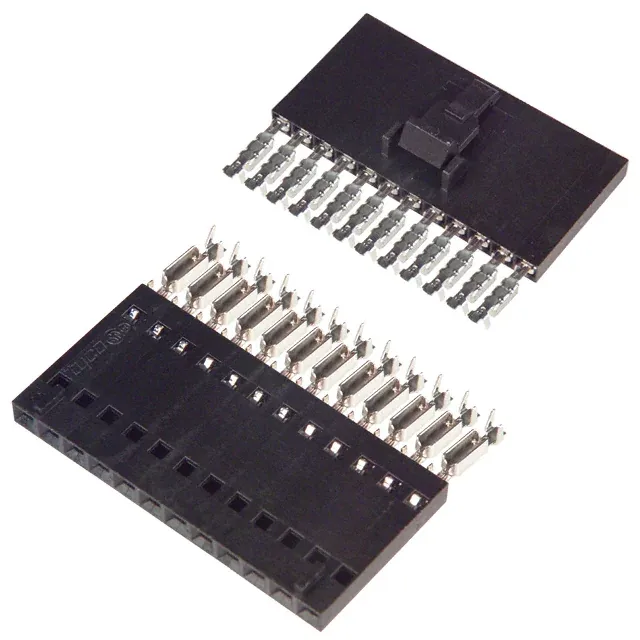
Termination and wire handling
The 22-26 AWG range covers common signal wire sizes; the slot geometry is fixed, so stay within that gauge and keep the insulation diameter within the IDC window (check the TE application drawing for the max insulation OD). The closed-end feature means the back of the housing is sealed — no wire pass-through, so the cable stops at the connector face. Accepts discrete or ribbon cable, which gives the harness builder routing flexibility: ribbon for a clean bundle to a header, discrete for point-to-point service loops.
Contact finish and signal duty
Gold resists oxidation on the mating interface, so the contact resistance stays stable over repeated mate cycles in a non-corrosive indoor environment. It is not a high-current or high-wear finish; the 15.0µin layer handles moderate mating cycles (typically 50-100 cycles) before the gold wears through. For a harness that sees frequent disconnect/reconnect in a clean environment, this is fine. For a high-vibration or corrosive setting, you would want a thicker gold or a different contact system.