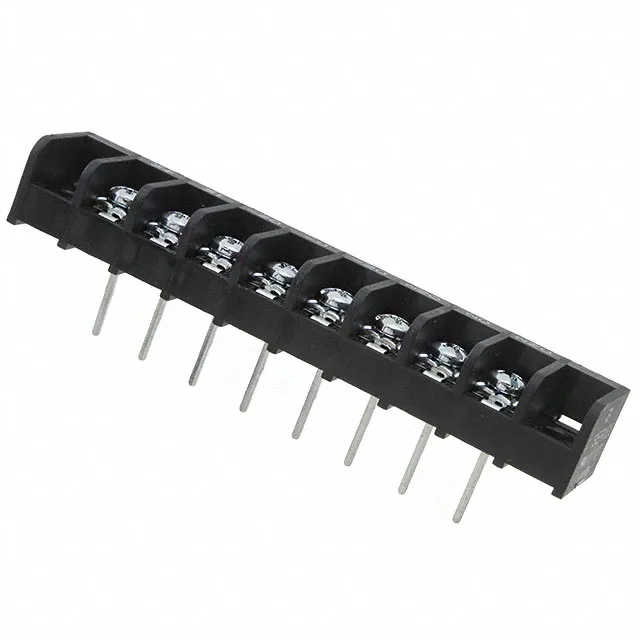
The TE Connectivity 6-1437649-7 is an 8-circuit barrier strip from the #4 Buchanan series, a workhorse line for point-to-point power and signal distribution inside equipment enclosures. The 0.325" (8.26mm) pitch gives enough spacing for 14 AWG wire and keeps creepage comfortable at the 150V rating — you can run a 20A load per circuit without worrying about flashover between adjacent terminals. The 3-wall barrier (Tri) design physically separates each position, so a stray screwdriver or a loose strand won't short two circuits. Bottom termination is wire-wrap, a legacy method where the stripped wire is wrapped around a square post. That tells you this strip was originally designed for wire-wrap backplanes or telecom frames; if your assembly expects a solder-tail or quick-connect tab, the wire-wrap post can still be soldered, but it's not the typical PCB-mount barrier block profile.
20A per circuit is the headline number — each terminal can carry a continuous 20A load at the rated 150V. That puts this strip in the mid-power range: it handles a motor drive, a power supply output, or a lighting circuit, but not a main bus bar. The 0.325" pitch is wide enough that adjacent wires at 20A won't overheat each other, but if you're running all 8 circuits at full current, you should check the total temperature rise inside the enclosure. Wire range is 14-22 AWG — the screw clamp will grip a solid or stranded conductor in that range. The captive plate prevents the wire from cold-flowing out under vibration, which is a common failure with plain screw terminals on stranded wire. Operating temperature is rated to 105°C, so the strip is fine inside a warm cabinet or near a heat source, but not for direct engine-bay or oven-adjacent use. Mounting options include chassis, panel, and through-hole — the flange (with stamped position numbers) lets you bolt the strip to a panel for a fixed installation, or you can solder the wire-wrap posts into a PCB. The 1-row layout keeps the strip narrow, so it fits in a crowded enclosure without taking up much rail space.