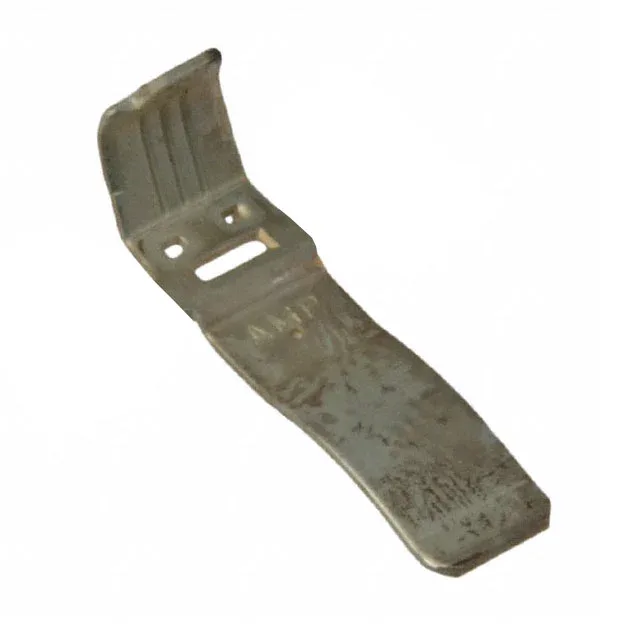
Unlike a standard pin or socket terminal, the brush contact uses a flat, spring-like wiping surface — it's made for applications where the contact slides against a mating surface, such as a motor commutator, a grounding brush, or a sliding power take-off. The crimp barrel secures the wire, and the brush end provides the sliding electrical connection. It's not a wire-to-board or wire-to-wire terminal in the usual sense; the mating half is a flat bar or commutator segment, not another crimp terminal.
The terminal accepts 14-20 AWG stranded wire — a broad range covering common power and signal leads in motor and industrial applications. The crimp termination is a standard open-barrel style, compatible with most manual or automated crimp tools for this wire range. The terminal is supplied in Tape & Reel packaging, suitable for automated assembly, and also available in Cut Tape for smaller runs.