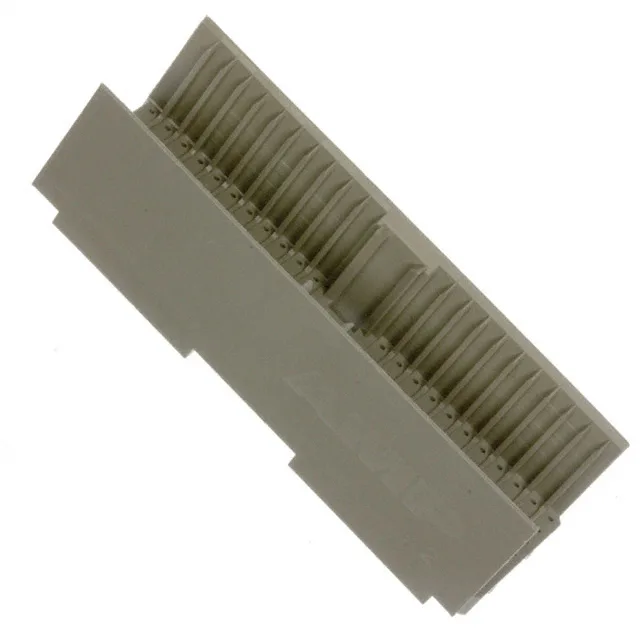
The TE Connectivity 646478-5 is a Z-PACK hard metric Type A shroud designed to guide and protect male pin headers in backplane-to-daughtercard interconnects. This is the receptacle-side frame — it does not carry pins itself. With 154 positions arranged in a 5 + 2 row configuration (five signal rows plus two outer shield rows) on a 2.00 mm pitch, it matches the standard hard metric footprint specified in IEC 61076-4-101. The gray housing is through-hole mounted and comes in tray packaging.
What the 154 Positions and 5+2 Row Count Mean for Your Backplane Layout
The 154-position count in a 5 + 2 row arrangement means this shroud accepts a mating header with 154 signal pins plus dedicated shield contacts in the outer rows. The 5 + 2 row pattern is the Type A variant of the hard metric standard — the five inner rows carry signals, and the two outer rows provide a ground shield plane that reduces crosstalk between adjacent columns.
The listing explicitly states contacts are not included. This shroud arrives as an empty plastic frame — the male pins that populate the 154 positions must be ordered separately as Z-PACK crimp or press-fit terminals. A common mistake is ordering only the shroud and discovering the backplane has no pins during assembly.
Lifecycle and Compliance — Active Production, ROHS3 Compliant
No obsolescence notice or last-time-buy window is in effect, so this shroud can be specified into new backplane designs without near-term supply risk. The ROHS3 compliance covers the full substance restriction list, including the four phthalates added in the 2015 amendment.
Mating and Termination — What Connects to This Shroud
This shroud mates with Z-PACK hard metric Type A male pin headers that carry the corresponding 154-position, 5 + 2 row pin arrangement on the same 2.00 mm pitch. The through-hole mounting style allows the shroud to be wave-soldered to the backplane. The shroud's internal keying and polarization features prevent mis-mating with non-Type A headers — the physical keying is built into the shroud walls, so a Type B or Type C header will not insert.