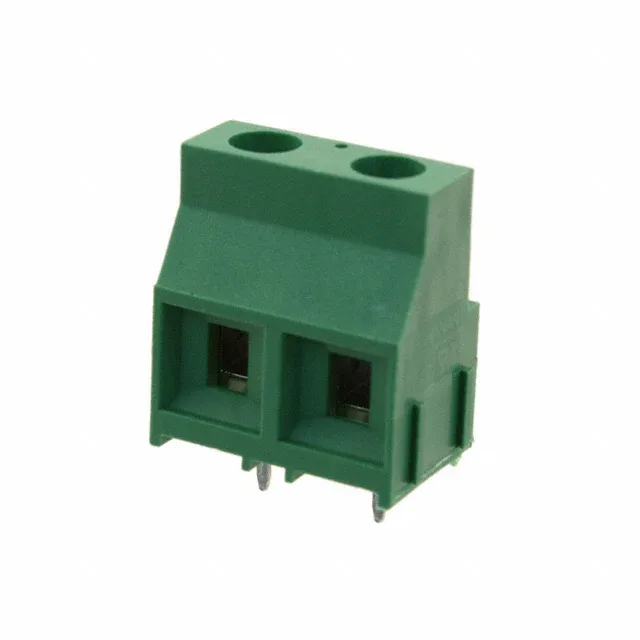
What This Terminal Block Does That a Screw-Clamp Should
The TE Connectivity 796690-6 is a 6-position Buchanan PCB terminal block on 0.197" (5.00 mm) centers — the pitch that matches the board layout for a 6-circuit power or signal distribution point. The rising cage clamp (screw - rising cage clamp) pulls the stripped wire into a tin-plated brass cage, not under the screw head, so the connection stays gas-tight across the full 12-30 AWG range. Green housing, single-level, through-hole mount. Side interlocking (Interlocking (Side)) lets you snap multiple blocks together to build a wider terminal strip without a separate jumper bar — useful when a 6-position block is short and you need 12 or 18 on the same pitch.
Wiring and Torque — What the Cage Clamp Needs
The M3 screw takes a torque of 0.79 Nm (7.0 Lb-In) — enough to deform the wire strand into the cage without stripping the brass screw. Under-torque it and the connection can loosen with thermal cycling; over-torque it and the screw head or cage thread strips. The clamp material is brass - tin plated; the screw is brass - nickel plated. Both are rated for the 300 V, 17.5 A per-position duty, but the plating choice (tin on the clamp, nickel on the screw) is about corrosion resistance in the screw-thread interface, not contact resistance — the wire-to-cage joint is the current path.
Orientation and Stacking — Fitting It Into the Enclosure
The wire termination angle is 35° (145°) relative to the board — the wire exits at an angle, not straight up. That saves vertical clearance in a shallow enclosure (think control cabinet door or junction box lid) while keeping the screwdriver access aligned with the screw axis. The side interlocking (Interlocking (Side)) is a dovetail-style tab-and-slot: push two blocks together and they lock without tools. No extra hardware, no alignment pins — just snap and solder.