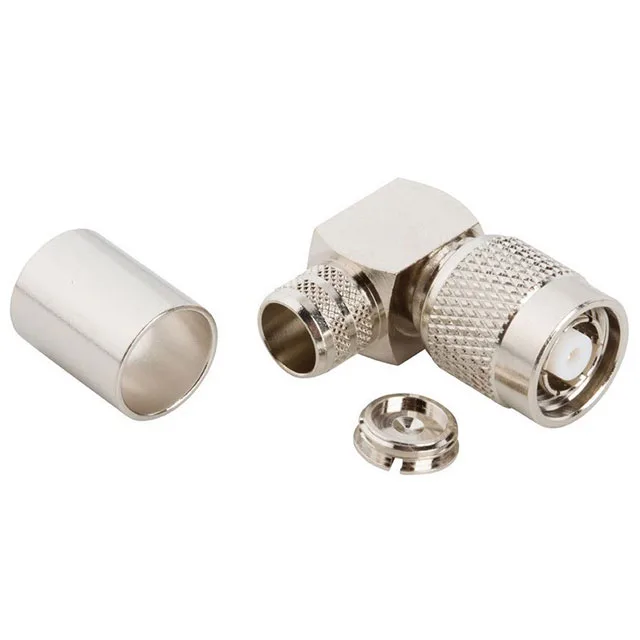
RP-TNC Plug Kit for Belden 9913 and LMR-400
The Amphenol RF 122416RP is a reverse-polarity TNC (RP-TNC) plug kit built for 50 Ohm coaxial cable assemblies. The RP-TNC interface swaps the gender roles of the centre contact: this plug carries a female socket, which mates with a male-pin RP-TNC jack. That polarity reversal is standard in applications where the antenna or radiating element needs a female centre contact on the cable side. The kit is specced for Belden 9913, Belden 9914, and LMR-400 cables — all low-loss 50 Ohm coax with similar dielectric diameters and braid coverage. The threaded coupling nut gives a vibration-resistant mate, and the gold-over-nickel finish on the brass body keeps corrosion at bay in field-deployed or outdoor radio gear.
The 122416RP is listed for Belden 9913, 9914, and LMR-400. These cables share a 0.405-inch nominal jacket OD and a solid or stranded centre conductor around 0.108 inch. The centre contact is solder-type — tin the conductor, flow solder, and inspect for voids. The shield termination is crimp: the ferrule slides over the braid and the connector body, then a hex crimp die compresses it. No special prep beyond standard coax stripping for these cable types. The PTFE dielectric in the connector body matches the cable dielectric, keeping the impedance transition clean through the termination zone.
RF Performance and Operating Range
The 122416RP is rated to 11 GHz maximum frequency with a 0.18 dB insertion loss figure. That loss is measured across the connector pair in a matched 50 Ohm system — it accounts for the impedance step through the interface and the centre contact junction. The voltage rating is 500 V, which for a 50 Ohm RF connector is more a dielectric withstand limit than a power-handling spec; at microwave frequencies the practical limit is set by the 11 GHz bandwidth and the PTFE dielectric's breakdown. Mating cycles are rated at 500 — typical for a threaded TNC interface. The gold-plated centre contact and nickel-plated brass body resist fretting corrosion over repeated connects and disconnects in field-service or test-equipment use. The threaded coupling nut provides positive mechanical retention; the connector won't unmate under cable strain or vibration the way a push-on connector might.