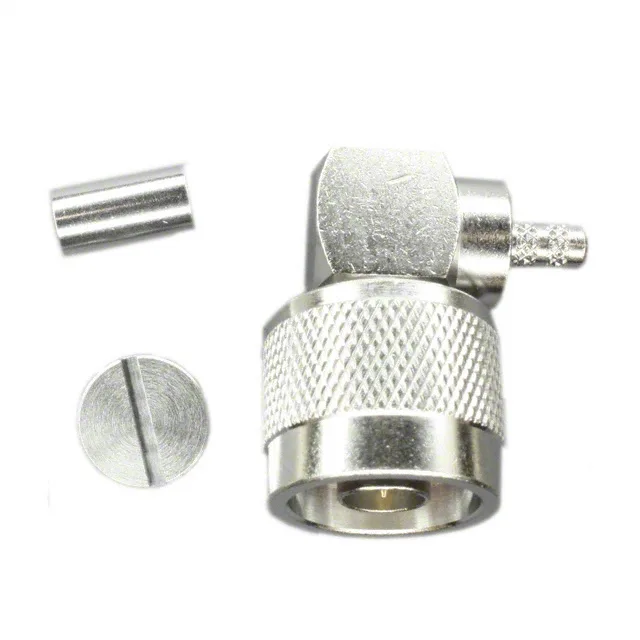
The 172177: It sits in the standard N-type 50 Ohm interface family, delivering a rated impedance of 50 Ohms and a maximum operating frequency of 11 GHz — well above the typical 10 GHz ceiling of many N-type plugs, so it holds the bandwidth for modern RF links without the insertion loss climbing early. You get everything needed to complete one cable assembly in a single order code — no guessing which ferrule fits. The right-angle body routes the cable exit perpendicular to the connector axis, which is the standard choice when the cable needs to fold flat against a panel or chassis wall.
RF Interface and Cable Fit
Cable groups include RG-58, 58A, 58B, 58C, 141, 303, LMR-195, Belden B7806A, and 9907. That covers the common thin and medium-diameter coax used in test leads, short antenna feeds, and indoor base-station runs. If your cable is not on this list, check the diameter and dielectric fit — the crimp ferrule and end cap are sized for this group. The shield is terminated by crimp, and the center contact by solder. Crimp gives a strong, repeatable mechanical grip on the braid; solder on the pin ensures a gas-tight electrical joint at the signal path.
Insertion loss is listed at 0.15 dB — a tight figure that keeps signal power from bleeding off across the joint. The threaded fastening type ensures the pair stays mated under vibration or cable tug; the knurled coupling nut is the standard N-type interface.