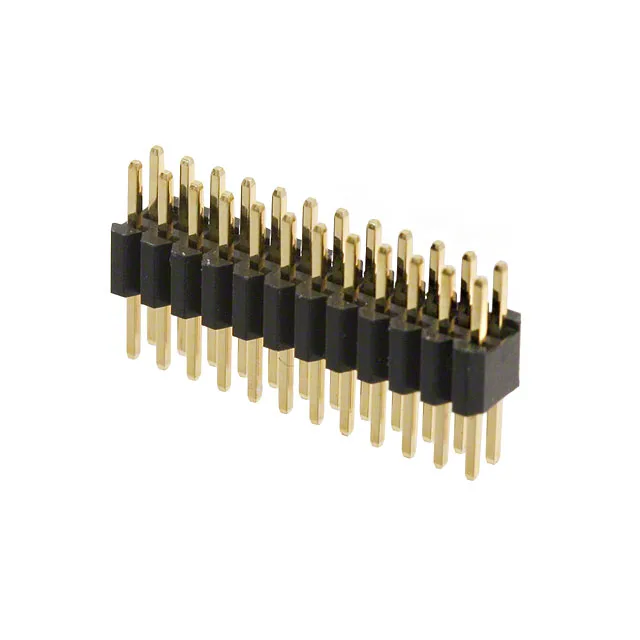
20021111-00024T4LF Minitek127 1.27mm Header 24-Position
FCI 20021111-00024T4LF Minitek127 1.27mm dual-row header, 24 positions, 2 rows, 0.050in (1.27mm) pitch, through-hole solder termination, gold on mating interface (10µin) tin on solder post (50µin), 1A per contact at 125VAC, push-pull fastening, UL94 V-0 black thermoplastic, -55 to 125°C.
Specifications
| Parameter | Value |
|---|---|
| Series | Minitek127® 1.27mm |
| Type | Male Pin |
| Mounting | Through Hole |
| Connector type | Header |
| Fastening type | Push-Pull |
| Voltage rating | 125VAC |
| Current rating | 1A per Contact |
| Operating temperature | -55°C~125°C |
| Contact material | Copper Alloy |
| Insulation color | Black |
| Insulation height | 0.098\" (2.50mm) |
| Insulation material | Thermoplastic |
All specifications
| Parameter | Value |
|---|---|
| Material flammability rating | UL94 V-0 |
| Style | Board to Board |
| Package | Tube |
| Shrouding | Unshrouded |
| Termination | Solder |
| Contact shape | Square |
| Rows | 2 |
| Pitch | 0.050\" (1.27mm) |
| Positions | 24 |
| Row spacing - mating | 0.050\" (1.27mm) |
| Contact finish - post | Tin |
| Contact length - post | 0.091\" (2.30mm) |
| Overall contact length | 0.309\" (7.86mm) |
| Contact finish - mating | Gold |
| Contact length - mating | 0.120\" (3.05mm) |
| Contact finish thickness - post | 50.0µin (1.27µm) |
| Contact finish thickness - mating | 10.0µin (0.25µm) |
Frequently asked questions
What does the 20021111-00024T4LF mate with?
The 20021111-00024T4LF mates with the matching Minitek127 1.27mm dual-row receptacle housing — the 24-position female connector with the corresponding 0.050-inch pitch and push-pull interface. Confirm the full mating half order code from the Minitek127 series datasheet before specifying.
What is the key rating that drives signal vs power selection on this header?
The 1 A per contact rating is the binding constraint — the 1.27 mm pitch supports the contact density, but the current per circuit is signal-level; the gold-on-mating / tin-on-solder split supports repeated mating cycles on the interface side without constraining the solder joint.