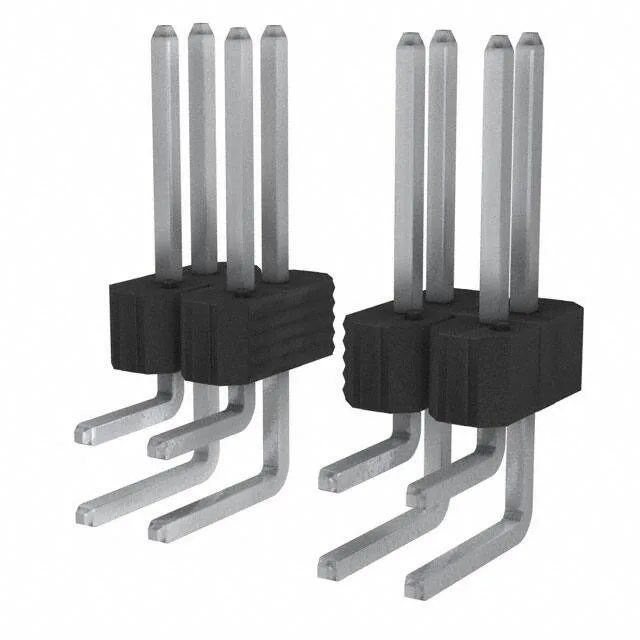
The Amphenol 68022-414HLF is a 14-circuit unshrouded male pin header from the BERGSTIK® II series, designed for board-to-board stacking where the mating receptacle sits parallel to the PCB. The 0.100" (2.54 mm) pitch and 0.100" row spacing match the legacy 0.1-inch grid layout that dominates prototyping, backplane, and peripheral card interconnects. Right-angle through-hole termination places the pin rows parallel to the board edge, which suits card-edge mezzanine or riser-card applications where the connector must sit flush against the enclosure wall.
Key ratings and what they mean for the fit
Rated 5 A per contact with tin-on-tin mating surfaces. The 100.0 µin (2.54 µm) tin plating on the mating side is thick enough for occasional mating cycles in a permanent-install board stack — think a PSU card plugged into a motherboard once at build time and left there. For frequent reconnection (test fixtures, field-swappable cards), the tin surface frets under vibration and the contact resistance drifts; a gold-plated sibling in the same series would be the better call for repeated mate cycles. The UL94 V-0 black housing carries the flame rating required for equipment inside an enclosure.
Mounting and termination
Through-hole right-angle mounting with a 0.110" (2.79 mm) solder post length — the tails sit flush for wave or hand soldering on a standard 0.062" board. The 0.318" (8.08 mm) mating pin length gives enough reach to engage a shrouded receptacle housing without bottoming out. Unshrouded, so there is no polarization key: the board layout must enforce orientation, and the mating half must be the matching BERGSTIK II receptacle or a shrouded header that accepts the 0.100" grid.
How it compares to the 68022-414BLF
The 68022-414BLF carries gold flash (light gold) on the mating contacts versus the 100.0 µ" tin on this -HLF variant. Both share the identical 14-position layout, 0.100" pitch, right-angle through-hole footprint, and UL94 V-0 housing. The plating difference governs the duty: the -HLF (tin) is a cost-optimized choice for one-time or low-cycle board stacks; the -BLF (gold) handles repeated mating cycles and corrosive environments better. Board layout and BOM position count are identical — the swap is purely a plating-grade decision.