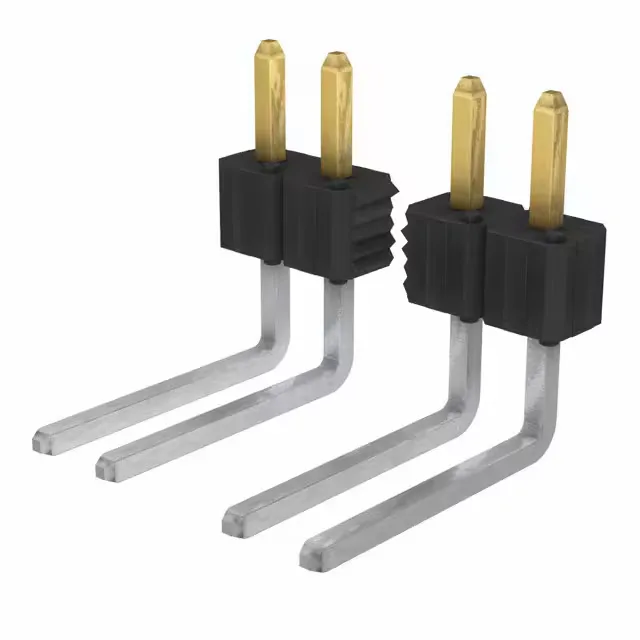
What This Connector Is
The Amphenol FCI 68023-228HLF is a 28-position single-row right-angle male header from the BERGSTIK® II series. It uses the standard 0.100" (2.54 mm) pitch — the same footprint as legacy pin headers — and terminates through-hole with solder. The unshrouded design with push-pull fastening means it mates with a standard female receptacle housing without a locking latch; the retention comes from the contact interference fit, not a mechanical lock.
Key Specs and What They Mean for the Fit
The 28 positions loaded all match the circuit count on the BOM line — no partial loading to account for. The 0.100" (2.54 mm) pitch is the classic 0.100-inch grid; any standard 0.100" female socket strip or IDC receptacle will mate. Right-angle orientation puts the pin axis parallel to the board, which is the typical choice when the mating cable exits along the board edge rather than perpendicular to it. Rated 5 A per circuit at 110 V — this is signal-level current, not bus-bar power. The real reliability spec here is the contact finish: 15.0 µin (0.38 µm) gold on the mating surface, with the option of Gold or Gold, GXT™. That gold thickness gives this header a solid mating cycle life for applications where the connector sees repeated disconnect and reconnect — field service, test fixtures, or modular assemblies. The phosphor bronze contact material is standard for this class; it springs well and resists stress relaxation at typical operating temperatures. The housing carries a UL94 V-0 flammability rating — required for equipment inside an enclosure where the connector must not propagate flame. Insulation height is 0.095" (2.41 mm), which is the standoff from the board surface to the bottom of the shroudless header body; the mating contact length is 0.136" (3.45 mm), and the post length below the board is 0.305" (7.75 mm) — enough to clear a standard 0.062" PCB and still leave a solder fillet visible on the back side.
Where It Gets Used
This is a board-to-board interconnect — the male header solders into one PCB and mates with a female socket strip on the other board. The unshrouded, right-angle form factor is common in mezzanine stacking where the two boards run parallel, or in cable-to-board applications when paired with a discrete-wire female housing. The gold plating and push-pull fastening suit it for environments where the connector is mated and unmated during service — think test points, programming headers, or modular card edges.