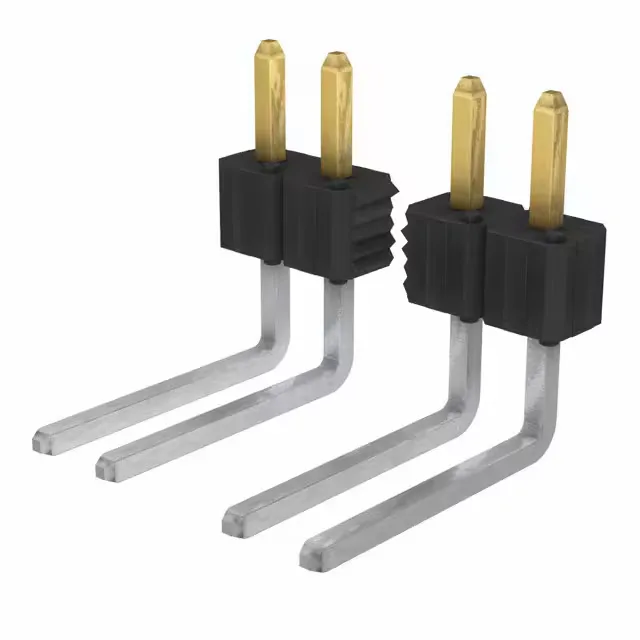
The Amphenol FCI 68023-231HLF is a 31-position unshrouded male pin header from the BERGSTIK II series, arranged in a single row on the standard 0.100" (2.54 mm) pitch. It terminates through-hole and exits the board at a right angle, which places the pin tips parallel to the PCB surface — a common orientation for board-edge I/O or mezzanine connections where the mating receptacle approaches from the side. The unshrouded design keeps the profile low and the footprint narrow, but leaves the pins exposed during handling, so the mating half needs to be aligned carefully on insertion.
Key Ratings and What They Mean for Fit
Rated 5 A per circuit with a 110 V voltage limit, this header handles signal-level current and moderate power distribution on a single board. The 5 A per pin is typical for a 0.100" pitch unshrouded header — the limiting factor is the temperature rise in the contact and the PCB trace, not the contact itself. The 31-position count at a 0.100" pitch means the populated row spans about 3.0 inches of board edge, so check that the enclosure or mating receptacle has that clearance. Contact plating is listed as gold or Gold, GXT™ at 15.0 µin (0.38 µm) thickness on the mating surface. The 15.0 µin gold layer provides good corrosion resistance and supports a reasonable number of mating cycles — suitable for field-serviceable connections where the connector is mated and unmated several times over the product life. The phosphor bronze base material offers a good balance of conductivity and spring properties for the square pin geometry. The right-angle through-hole termination means the solder tails extend 0.305" (7.75 mm) below the board surface. That post length is long enough for standard PCB thicknesses (0.062" to 0.093") with room for the solder fillet. The insulation height of 0.095" (2.41 mm) is the standoff between the housing bottom and the board — short enough that the header sits tight against the PCB.
Construction and Compliance
The housing is rated UL94 V-0, so it meets the flame-retardancy requirement for equipment inside an enclosure. The push-pull fastening type means there is no locking latch — retention relies on the friction of the pin-to-receptacle contact. For applications subject to vibration, a secondary retention method (like a wire-to-board housing with a latch) would be needed. All positions are loaded — no empty pin holes to work around.