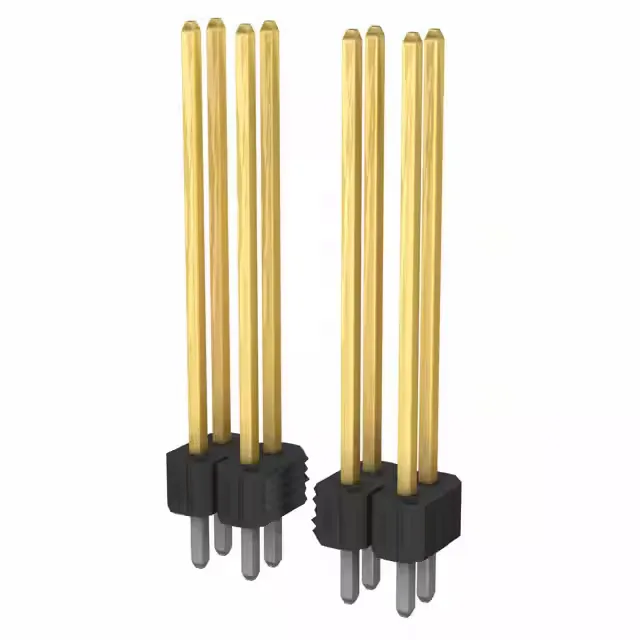
It uses the standard 0.100" (2.54mm) square grid on both pitch and row spacing, so it drops into any PCB laid out on that legacy 0.100-inch matrix — no footprint surprises. The push-pull fastening is the simplest retention there is: no latch to break, just the friction of the pin-and-receptacle interface holding the pair together. For a fixed installation inside a chassis that doesn't see vibration or frequent unmating, that's often exactly what you want. The 34 positions are all loaded — no skipped or dummy pins — so the BOM count is the circuit count.
If your board already has a 34-position, 2-row header footprint on 0.100" centers, this header fits without a layout change. The 0.120" (3.05mm) solder tail length is on the shorter side — it suits standard 1.6mm PCBs but won't protrude far enough for thick backplanes or boards with heavy copper pours. The overall contact length of 0.990" (25.15mm) with a 0.770" (19.56mm) mating section gives plenty of wipe for a solid connection. 5 A per contact is the headline current rating. That's typical for a signal-grade header on 0.100" pitch — it'll handle logic-level power and I/O lines without issue, but don't plan on running bus-level current through every pin simultaneously. The phosphor bronze contact material gives good spring properties and resists stress relaxation over temperature. The 110 V voltage rating is the working limit between adjacent contacts. For most logic-level and low-voltage signal applications that's plenty of headroom, but if you're switching 48 V or higher, stay within the derating guidelines for the application.