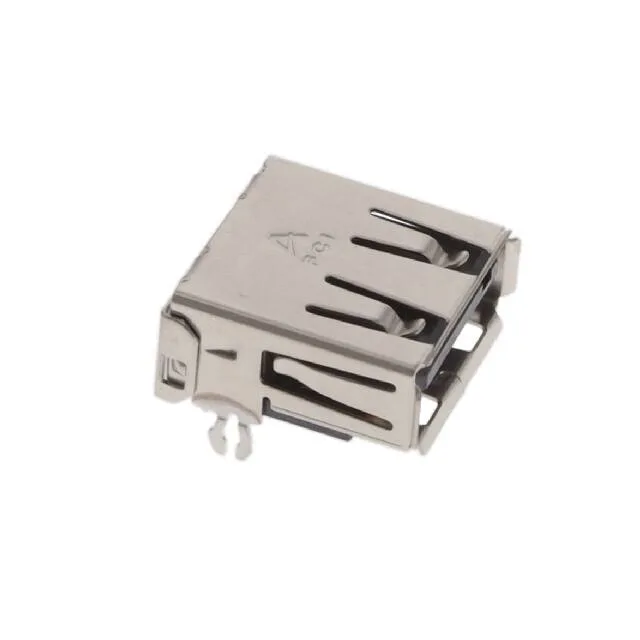
The -55°C~85°C operating range suits it for industrial enclosures or outdoor telecom gear where temperature swings are a concern.
The 4-contact count matches the standard USB-A pinout — D+, D-, VBUS, and GND — so the signal assignment is fixed. The USB 2.0 specification means the connector is rated for 480 Mbps data rates, backward-compatible with USB 1.1. The 3A per-contact rating is enough for bus-powered devices; derate above 85°C per the manufacturer's curve. The 1500 mating cycles are higher than a typical consumer USB jack — this connector is designed for equipment that sees regular plug/unplug cycles, like test fixtures or panel-mount ports. The board lock adds mechanical retention during soldering and vibration, which is useful for a right-angle connector that sees cable strain.
Through-hole, right-angle mounting places the USB port parallel to the PCB edge, typical for rear-panel or edge-card I/O. The solder termination requires wave or selective soldering; the board lock holds the connector in place during the process. The shielded shell — copper alloy — provides EMI containment for the USB differential pair, which is critical for passing FCC/CE radiated emissions testing.