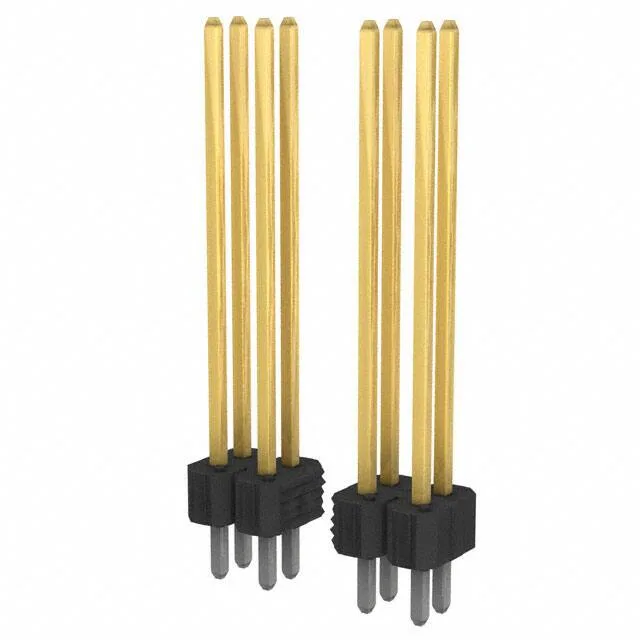
It sits on the standard 0.100" (2.54 mm) pitch grid — the same spacing as legacy DIP packages and breadboard prototyping boards — so it drops into a familiar footprint. The two rows are spaced 0.100" (2.54 mm) apart as well, giving a compact 58-pin array that fits a 29-per-row layout. Rated 5 A per circuit at 110 V, this is a signal-level interconnect; the 30 µ" gold plating on the mating surface handles repeated connect-disconnect cycles without the fretting corrosion you'd see with tin on a header that gets field-service unplugging.
Through-hole termination with 0.120" (3.05 mm) post length — the solder tail clears a standard 1.6 mm PCB and leaves enough stub for a reliable fillet. The overall contact length is 1.040" (26.42 mm), with 0.820" (20.83 mm) of that available for mating. That long mating pin is designed to reach into a standard IDC socket or a BergStik receptacle; the unshrouded body means there's no keying ramp to guide the mate, so the board layout has to provide the alignment. The insulation height is just 0.100" (2.54 mm) above the board, keeping the profile low for dense card cages.
Phosphor bronze contacts with 30 µ" (0.76 µm) gold on the mating interface — the gold thickness is enough for hundreds of mating cycles without exposing the base metal.