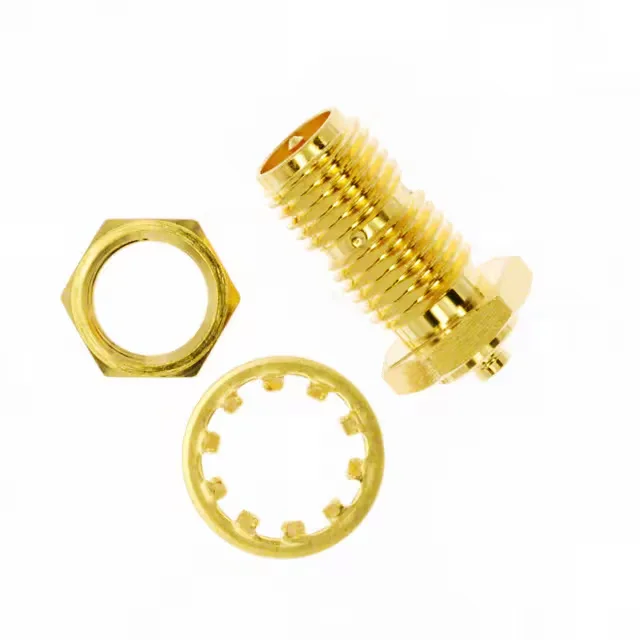
Between-Series RF Adapter for Antenna-to-Module Links
The Amphenol RF 901-10097 is a straight between-series adapter that converts an RP-SMA jack to a U.FL (UMCC) or AMC jack, with male center pins on both ends. This adapter bridges the gap between a standard threaded RP-SMA antenna port and the miniature snap-on U.FL connector found on WiFi modules, cellular radios, and IoT transceivers. The 50 Ohm characteristic impedance and 6 GHz frequency ceiling cover the 2.4 GHz and 5 GHz WiFi bands plus sub-6 GHz 5G NR spectrum, making it a common choice for prototyping and production antenna harnesses.
Panel-Mount Hardware and Temperature Range
The bulkhead mounting feature lets you fix the adapter through a chassis panel up to about 3 mm thick — the lockwasher bites into the panel to keep the adapter from rotating when you torque the mating RP-SMA cable onto it. The brass body with gold finish resists corrosion, and the PTFE dielectric holds the 50 Ohm line through the transition.
100 Mating Cycles — Service Life for Field Replacements
The adapter is rated for 100 mating cycles. That figure applies to the U.FL snap-on interface — the RP-SMA threaded side will last hundreds of cycles, but the miniature U.FL side is the wear item. For a production antenna harness that gets mated once and left alone, 100 cycles is plenty. For a test fixture or a field-swappable module, plan to replace the adapter when the U.FL side starts feeling loose. The gold-over-brass center contacts on both ends keep contact resistance stable across those cycles.
RP-SMA vs SMA — Why This Matters for Antenna Polarity
The RP-SMA side has a jack body with a male center pin — that is the reverse-polarity variant. Standard SMA uses a female center pin in the jack. WiFi access points and many embedded radios use RP-SMA to keep consumers from attaching standard SMA antennas with incompatible gain patterns. If your module has an RP-SMA jack, this adapter mates directly. If it uses standard SMA, you need the sibling 901-10175, which converts SMA (female socket) to U.FL. The center gender difference is the only functional distinction between the two — both are 50 Ohm, 6 GHz, bulkhead-mount adapters with the same hardware kit.