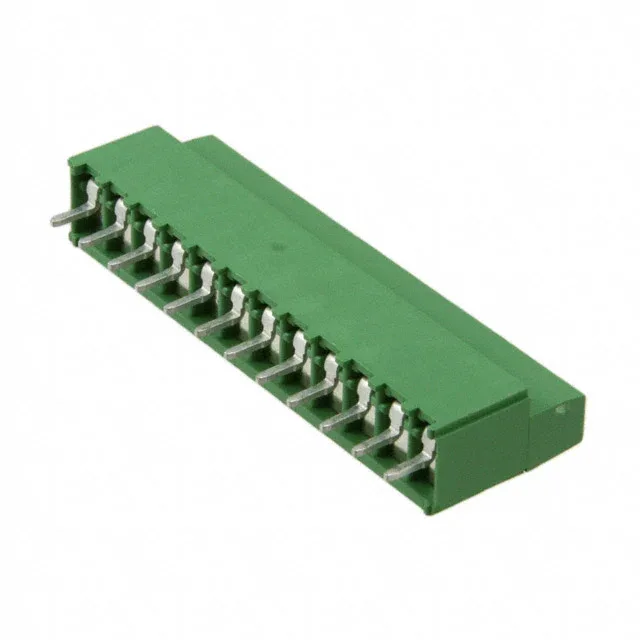
It terminates wires via a rising cage clamp — the screw drives a brass clamp plate up inside the housing, trapping the conductor against the current bar without twisting the wire. Rated 24 A at 300 V, it's built for power distribution inside control cabinets, panel wiring, and industrial equipment where you need a screw-terminated field connection on the PCB. The green polyamide 6/6 housing carries the side interlocking feature, so multiple blocks snap together to build wider assemblies on the same pitch.
The 24 A per-circuit rating assumes the full cross-section of the current path, not just the contact; at that current the temperature rise in the PA66 housing stays within the material's continuous-use limit.
Termination and Torque — What the Screw Setting Means
The rising cage clamp accepts wire from 12 AWG down to 30 AWG. The specified torque is 0.79 Nm (7.0 Lb-In) — that's the setting that pulls the clamp plate up far enough to grip the conductor without stripping the M3 brass screw. Under-torque it and the connection can loosen under thermal cycling; over-torque it and you risk cracking the housing or stripping the thread. The clamp plate and screw are both brass with nickel plating, which resists corrosion in cabinet environments.