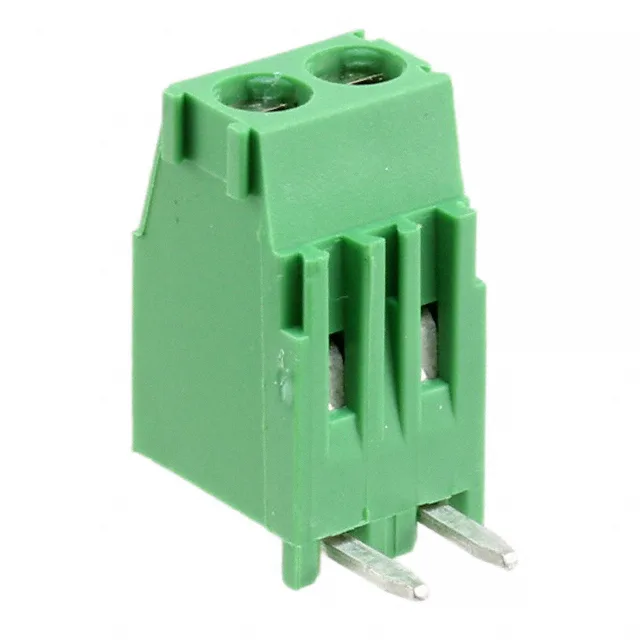
Terminal Block for PCB Power Distribution
The TE Connectivity Buchanan 284414-2 is a 2-position, single-level PCB-mount terminal block with a 3.50 mm pitch and top-entry screw termination. It is designed for terminating field wiring directly to a printed circuit board, commonly used in industrial control panels, power supplies, lighting ballasts, and building automation equipment where a reliable, serviceable wire connection is needed at the board edge. Each position is rated for 12 A at 300 V, which places this block squarely in the power interconnect category — not a signal-level header, but a point where power enters or leaves the PCB. The housing is molded in green polyamide (PA66/Nylon 6/6), the standard color for European-style PCB terminal blocks, making it visually identifiable in a mixed-component panel. The block is supplied in bulk packaging, which suits manual assembly or selective soldering lines.
Wire Termination and Field Service
Wire termination uses a Screw - Rising Cage Clamp mechanism. Turning the M3 screw (torque spec 0.25 Nm / 2.2 Lb-In) lifts a nickel-plated brass cage that accepts stripped solid or stranded wire from 12 AWG down to 30 AWG. The cage clamp applies even pressure across the conductor, avoiding the cold-flow issues common with screw-point terminations on stranded wire. The contact material is brass with tin plating, which is adequate for the 12 A rating and typical industrial environments. For applications requiring higher corrosion resistance or frequent re-termination cycles, the tin-plated contact surface should be evaluated against the expected service conditions. The mating orientation is vertical with the board — wires enter from the top, perpendicular to the PCB surface. This is the standard arrangement for board-edge terminal blocks where the wire bundle runs parallel to the board plane.
Ganging Multiple Blocks
The Interlocking (Side) feature allows multiple 284414-2 blocks to be mechanically snapped together side-by-side to form a multi-position terminal strip of any length. When ganged, each block remains independently replaceable. The interlock does not carry current — it is purely mechanical alignment. Electrical continuity between adjacent positions is handled by PCB traces or optional jumper bars, not by the interlock itself.