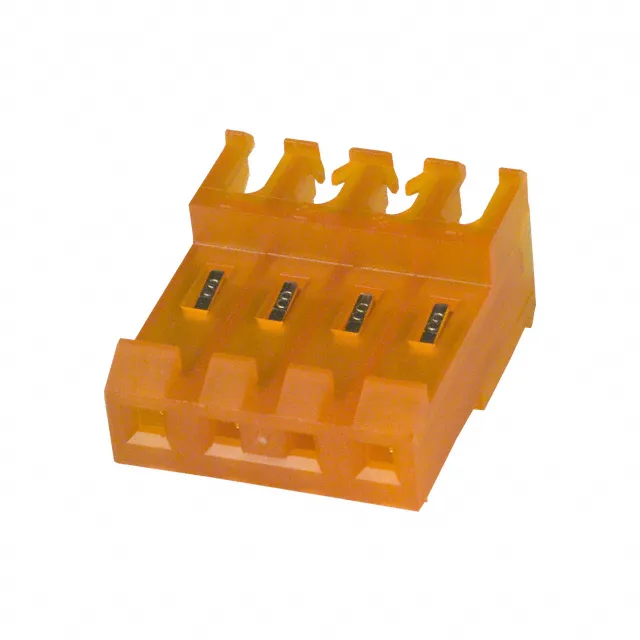
The 3-640599-4: It terminates discrete or ribbon cable via IDC — no crimping, the wire insulation is punched directly into the slot. The 0.156" (3.96mm) pitch matches the MTA-156 header family, so the board footprint is set by that spacing. The orange housing is a visual identifier on the harness, not a functional spec.
IDC termination and wire gauge — what fits
This receptacle is specced for 18 AWG wire — that's a single gauge, so the slot width is fixed. Use the correct insulation OD for MTA-156 tooling; too thick and the wire won't seat, too thin and the grip is loose. The feed-through feature lets the wire pass straight through the housing, useful for daisy-chaining in a harness.
Locking ramp keeps the pair mated
It's a positive latch — you hear it click. For a wire-to-board connection in a moving assembly or moderate vibration, that latch holds the pair together without a secondary lock. The free-hanging mount means this receptacle is the cable side; the header is the board-mount half.
Tin contacts — 80.0µin thick for repeated mates
That's a thick tin layer — standard flash tin is around 30-50µin. The extra thickness buys more insertion cycles before the tin wears through and exposes the base metal. It's still a tin-to-tin interface, so the mating cycle life is lower than gold, but for a connector that sees occasional unmate-and-remate in service (not daily cycling), this plating is cost-effective. Tin is also the standard for MTA-156, so mixing tin receptacle with tin header is the intended match.
Mating with the MTA-156 header
The header is typically board-mount (vertical or right-angle) with the same locking ramp. The 18 AWG IDC termination is the receptacle side; the header side accepts the same gauge wire or board trace. No adapter or conversion is needed — straight MTA-156 to MTA-156.