What it is and where it fits
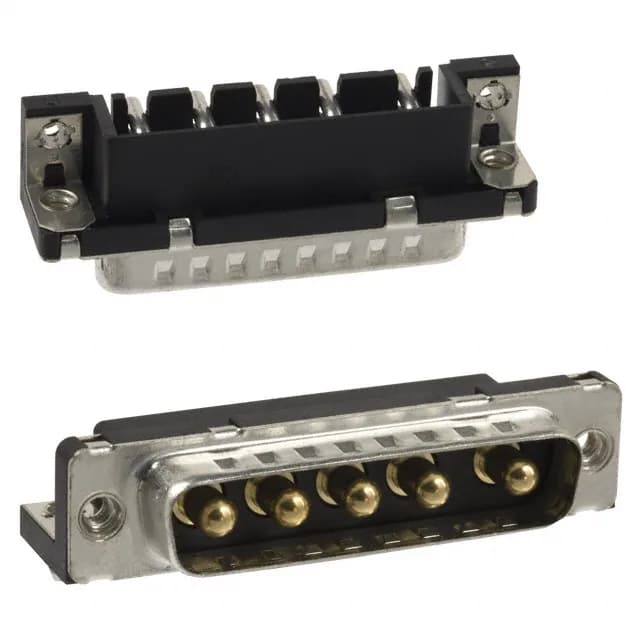
The D5W5P36A6GX08LF is a 5-power-position, right-angle through-hole D-Sub combo plug in the Delta D series. Five brass contacts, each rated 30 A at 300 V, carry the current; the mating face gold plating is 30 µin (0.76 µm) on 30 µin total thickness, giving the wipe durability needed for a power connector that sees repeated mating cycles. The steel shell carries a board-lock feature and dedicated mounting brackets with a 4-40 flange pattern — those brackets are what distinguish this variant from the otherwise electrically identical D5W5P36A6GV08LF, which uses a mating-side female screwlock (4-40) instead. Both are size 3 (DB, B) shells with a 0.374-inch backset; the 5W5 layout places five power contacts in the standard D-sub pin array.
Board fit and stack-up
Right-angle through-hole termination means the connector seats perpendicular to the board plane and the tail projects through to the solder side. The 0.374-inch backset (9.50 mm) defines the seating plane offset from the board edge — confirm the keep-out zone against your board thickness and any adjacent tall components. The nickel-plated steel shell with grounding indents drains shield current at the face before it reaches the contacts, which matters in noisy power-distribution environments. The UL94 V-0 thermoplastic housing supports the full -55°C to 125°C operating window, so thermal cycling during wave or hand-solder rework stays within the rated envelope.
Second-source — D5W5P36A6GV08LF
The D5W5P36A6GV08LF is the functional second-source candidate: same Delta D series, same 5 power positions, same 30 A at 300 V, same gold-plating thickness, same right-angle through-hole footprint. The sole mechanical delta is the flange feature — the D5W5P36A6GX08LF carries mounting brackets (4-40) while the D5W5P36A6GV08LF uses a mating-side female screwlock (4-40). Either variant fits the same board footprint and seats in the same shell size; panel designers choosing between them are selecting the fastener method, not changing electrical performance. If your BOM already specifies one flange type, swapping to the other requires confirming the mating half's jack-screw or screwlock hardware matches.