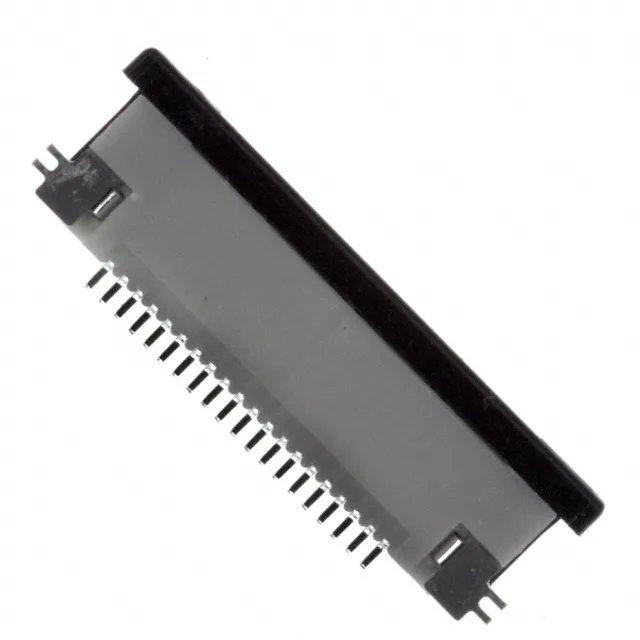
What this 20-position ZIF connector does in the assembly
It accepts a 0.30 mm thick flat flex cable with a tapered end, and the slide lock actuates the zero insertion force mechanism — the cable is inserted with the lock open, then the slide is pushed to clamp the contacts against the FPC pads. This design reduces wear on the cable pads compared to a non-ZIF connector, which matters when the cable is disconnected and reconnected during field service or testing. The top-contact configuration means the connector engages the conductive pads on the upper side of the FPC. This is a fit gate: if your cable has pads on the bottom side, you need the bottom-contact sibling 20FLZ-RSM2-TB instead.
At 0.50 mm pitch, the 20 positions occupy about 10 mm of board edge — the footprint is tight enough for dense routing but still hand-solderable under magnification. For signal-level circuits (logic, sensor, display data), 0.5 A is ample. If any circuit needs more than 0.5 A, this connector is not the right choice — look at a wider-pitch series like JST's FH or SH. The 2.00 mm height above board keeps the connector low-profile, useful when the mating cable must fold over the connector or when the assembly sits in a tight z-height enclosure.