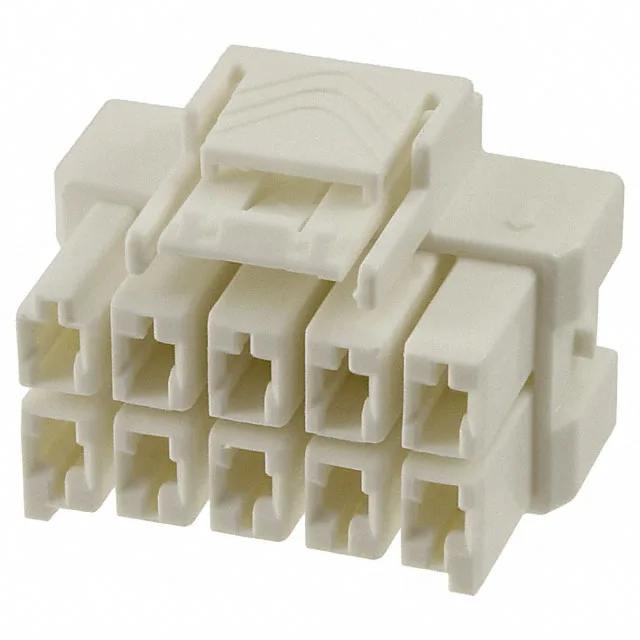
The 6.00 mm pitch and 0.319" (8.10 mm) row spacing give it the creepage distance to handle higher-voltage power circuits without tracking, while the glass-filled PBT housing holds its shape through the -55°C to 150°C operating range — typical for underhood automotive or industrial cabinet environments where the connector sees both heat and cold soak. The housing is keyed so it can only go in one way, which keeps the assembler from forcing a misaligned pair and damaging the terminals.
What Mates and What Fits — Terminal and Header Compatibility
This plug housing accepts TE Power Triple Lock female blade socket crimp terminals (order separately). The housing mates with the matching Power Triple Lock receptacle headers (through-hole or right-angle) to complete a wire-to-board interconnect rated for the same 6.00 mm pitch grid. The natural PBT colour is the standard unkeyed version; the latch holder provides primary retention, and the dual-row cavity layout accepts up to 10 circuits in a 2 x 5 arrangement. No secondary TPA (terminal position assurance) is listed for this housing, so terminal lock integrity depends on the crimp terminal's own latch and the assembler's feel.
10 vs 6 Positions — Same Series, Different Circuit Count
The closest same-series peer is the 1-1644055-3, a 6-position Power Triple Lock plug housing at 6.35 mm pitch. The 1-1971776-5 carries 10 positions at 6.00 mm pitch — four more circuits in a slightly tighter pitch, which matters when the BOM calls for 10 power circuits and the board real estate is fixed. Both use the same latch holder fastening and free-hanging mount, so the harness assembly process is identical; the choice comes down to position count and the 0.35 mm pitch difference, which is negligible for terminal fit but affects the overall housing width.