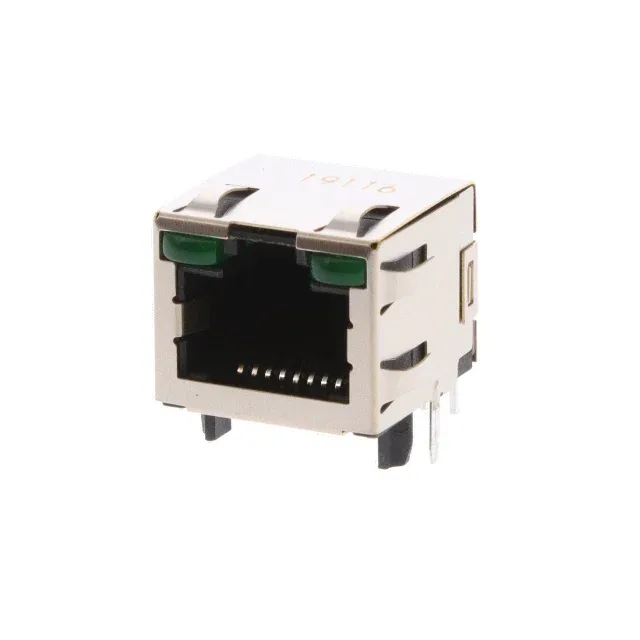
RJ45 Jack for Cat5 Ethernet — Shielded, Right-Angle, with Status LEDs
It is a right-angle, through-hole mount jack with a shielded body and integrated EMI fingers for grounding the cable shield to the chassis. The connector is rated for Cat5 applications, supporting frequencies up to 100 MHz, which covers 100BASE-TX and 1000BASE-T Ethernet. Dual green LEDs provide link and activity status indication directly on the connector face.
Shielding and EMI Performance
The shielded construction with EMI fingers is the key feature for passing radiated emissions testing. The EMI fingers contact the panel cutout, creating a low-impedance path from the cable shield to chassis ground. This is critical in equipment enclosures where the jack is mounted at the board edge and the cable shield must be terminated before the signal reaches the PCB. The Cat5 rating confirms the connector meets the insertion loss and return loss requirements for 100 MHz operation.
LED Configuration and Visual Indication
The jack carries two green LEDs. In a typical Ethernet application, one LED indicates link status (solid on when a link is established) and the other indicates activity (blinks with traffic). The LEDs are integrated into the connector body, saving board space compared to separate discrete LEDs. The tab direction is up, meaning the latch on the mating RJ45 plug faces upward when the connector is mounted on the top side of the PCB.
Contact Plating and Mating Durability
This thickness is standard for moderate mating cycle applications — typically 750 to 1500 cycles — and provides corrosion resistance in non-sealed environments. The gold-over-nickel underplate prevents diffusion of base metal through the gold layer. For a fixed installation like a wall plate or switch port, this plating grade is more than adequate; for a field-serviceable connector with frequent reconnects, a thicker gold flash would be specified.
Board Guide and Assembly
The jack includes a board guide feature, which consists of plastic alignment posts that help position the connector during wave soldering. This prevents skewing and ensures the connector sits flat against the PCB. The through-hole termination provides a stronger mechanical bond to the board than SMT, important for a jack that sees cable insertion and removal forces. The housing is thermoplastic, UL 94 V-0 rated for flammability.