Right-angle header for board-edge wire routing
The 4.14mm pitch and 0.163" row spacing are wide enough to route 20-24 AWG wire without crowding, and the shrouded 4-wall design protects the male pins from accidental bending during handling or mating.
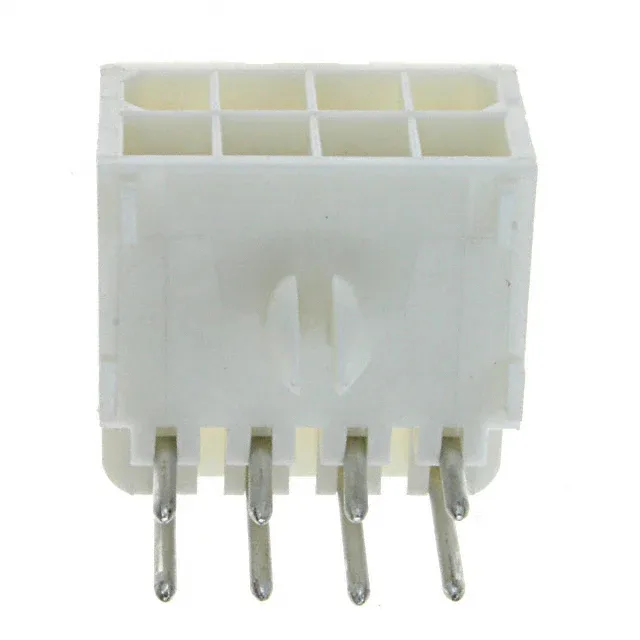
TE Connectivity AMP Mini-Universal MATE-N-LOK header, 1-770970-0, 8-position, 4.14mm pitch, right-angle through-hole, shrouded 4-wall, locking ramp, board lock, tin-plated contacts, UL94 V-0 nylon, 600VAC rating.
| Parameter | Value |
|---|---|
| Series | Mini-Universal MATE-N-LOK |
| Type | Male Pin |
| Mounting | Through Hole, Right Angle |
| Connector type | Header |
| Fastening type | Locking Ramp |
| Voltage rating | 600VAC |
| Current rating | Varies by Wire Gauge |
| Operating temperature | -20°C ~ 85°C |
| Contact material | Brass |
| Insulation color | White |
| Insulation height | 0.386\" (9.80mm) |
| Insulation material | Polyamide (PA), Nylon |
| Parameter | Value |
|---|---|
| Material flammability rating | UL94 V-0 |
| Style | Board to Cable/Wire |
| Package | Bulk |
| Features | Board Lock |
| Shrouding | Shrouded - 4 Wall |
| Termination | Solder |
| Applications | General Purpose |
| Contact shape | Circular |
| Rows | 2 |
| Pitch | 0.163\" (4.14mm) |
| Positions | 8 |
| Row spacing - mating | 0.163\" (4.14mm) |
| Contact finish - post | Tin |
| Contact length - post | 0.145\" (3.68mm) |
| Contact finish - mating | Tin |
| Contact finish thickness - post | 150.0µin (3.81µm) |
| Contact finish thickness - mating | 150.0µin (3.81µm) |
The 4.14mm pitch and 0.163" row spacing are wide enough to route 20-24 AWG wire without crowding, and the shrouded 4-wall design protects the male pins from accidental bending during handling or mating.
The 1-770970-0 mates with a Mini-Universal MATE-N-LOK receptacle housing that accepts crimp terminals. The matching receptacle part numbers depend on the circuit count and wire gauge; typical mates include the 1-480698-0 series for 8-position receptacles.
For typical 20 AWG wire, the contact is rated around 5A per circuit; always consult the derating curve for your specific wire gauge and ambient temperature.