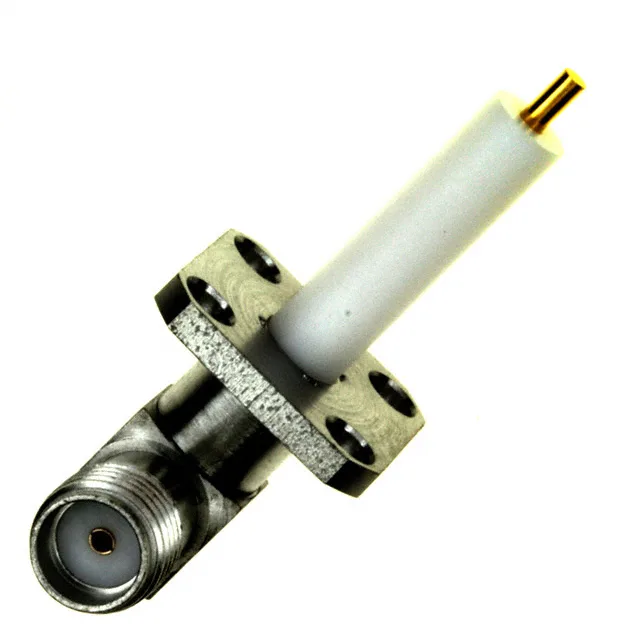
The 1052978-1: It sits as a single-port, panel-mount SMA jack with a right-angle body orientation — the signal exits parallel to the mounting surface, which suits enclosure feed-throughs and bulkhead applications where the cable run needs to turn immediately. The flange mounting feature lets you bolt it to a panel with four screws, and the threaded fastening provides a vibration-resistant mate that won't loosen under thermal cycling or mechanical shock. Rated to 12.4 GHz maximum frequency, this SMA covers L-band through X-band — radar, test instrumentation, and microwave links are the typical deployment. The 500 mating cycles, backed by a gold-plated beryllium copper center contact, mean it survives repeated reconnections in a test-stand or field-service environment without the contact resistance drifting.
Panel mount with a flange, right-angle orientation — the connector body sits flat against the panel and the signal path turns 90 degrees. The threaded coupling nut on the mating SMA plug engages with the receptacle's threads — hand-tighten plus a quarter turn with a wrench is the standard SMA torque.
What the 12.4 GHz Rating Means for the Signal Path
The 12.4 GHz frequency ceiling is the upper end of the connector's usable bandwidth. Below that, the VSWR stays under the SMA interface's typical 1.3 limit (the datasheet confirms this through the 50 Ohm impedance and PTFE dielectric). If your signal chain runs at 10 GHz, this connector passes it with minimal reflection; push past 12.4 GHz and the mode structure in the SMA interface starts to degrade, so you'd step up to a 2.92 mm or SMPM connector. For DC-to-12.4 GHz work, this is a clean fit.