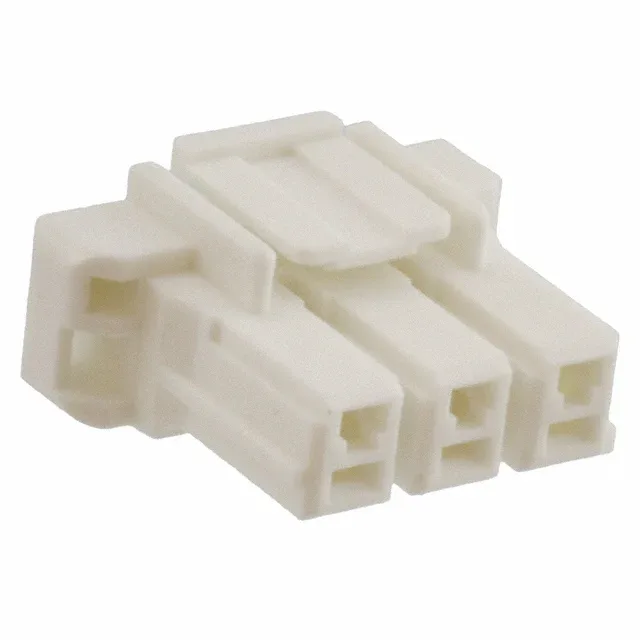
The 5.00 mm pitch is a key dimension for board layout if you're matching to a PCB header — it's wide enough to handle moderate power levels without forcing tight routing. The single-row, 3-position layout keeps the footprint compact for applications where only three circuits are needed. The glass-filled nylon housing holds its shape under the clamp force of the latch lock and resists creep at the upper temperature end.
The Contacts Trap — Why This Housing Ships Empty
The single most important fact about this part: contacts are not included. This is not a mistake in the listing; it's how the Power Key series is sold. The housing accepts the TE Power Key crimp contacts (typically ordered as a reel or strip of loose pieces). If your BOM lists only this housing number, the harness can't be assembled until the terminals are added. The contact termination is crimp, which means you'll need the appropriate crimp tooling (typically a hand tool or a press with the correct applicator for the wire gauge range the contacts accept). The housing itself has no solder points — it's a pure wire-to-wire or wire-to-board interconnect shell.
Where This Housing Fits in the Power Key Series
For a 3-position, single-row, 5.00 mm pitch plug housing, the 1376389-1 is the active, standard offering. No direct second-source is on record — the listed peers are either different pitch, different position count, or different connector type (receptacle).
Latch Lock and Free-Hanging Mount — Built for Vibration
The latch lock fastening type means the housing clicks into the mating header or receptacle and stays there under vibration. This is a deliberate design choice for automotive and industrial applications where a loose connector means an intermittent fault. The free-hanging (in-line) mount style means the housing is designed to be part of a cable harness, not panel-mounted or board-mounted — it sits in the wire run, not on a chassis or PCB. The natural (uncolored) PA66 housing has no pigment, which avoids any long-term color-fade or pigment-migration issues in high-heat environments. The glass fill adds stiffness to the latch arm so it doesn't fatigue after repeated mating cycles.
Sourcing This Housing Today
For procurement: this is a standard catalog item. Remember to add the crimp terminals to the BOM as a separate line.