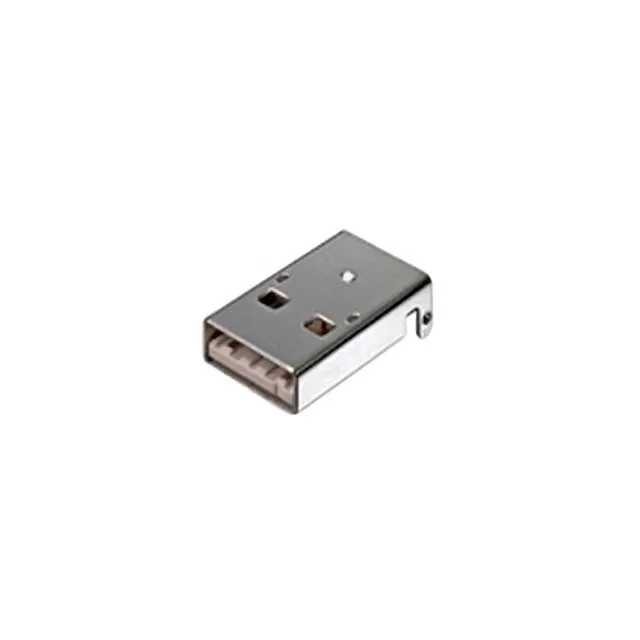
It carries 4 contacts in a single port and is shielded with a steel (SPCC) shell to keep EMI off the data lines — the same shell that gives the connector its familiar rectangular profile. Gold plating on the contacts handles the 1500 mating cycles this part is rated for, which is well above the 500-cycle baseline for a basic USB connector; this one was built for repeated plug-unplug duty in a panel or device that sees regular field access.
Mounting and Environment
The mounting is a hybrid — surface mount, right angle with through-hole support — listed as both Surface Mount, Right Angle and Through Hole. That means the signal pins reflow onto the board pads while the shell legs solder into plated through-holes for mechanical retention. The operating temperature range is 0°C to 50°C, which is tight: this connector was designed for indoor consumer or commercial equipment, not an automotive cabin or an outdoor enclosure.
No direct replacement is documented, so a cross-reference search or a board redesign to a current USB-A connector may be needed for new production.
The 1.5A per contact rating at 30VDC is standard for a USB 2.0 power line — enough for a 7.5W device draw across the VBUS pin, but not for a high-power charging port. The 1500 mating cycles mean the gold plating is thick enough to survive years of daily connect-disconnect in a field-service scenario; a standard tin-plated USB connector would fret and fail long before that count. The shielded steel shell mates with the receptacle's ground fingers to bleed common-mode noise before it reaches the differential data pair, which is why USB 2.0 signal integrity holds up to the 480 Mbps data rate without extra ferrites.