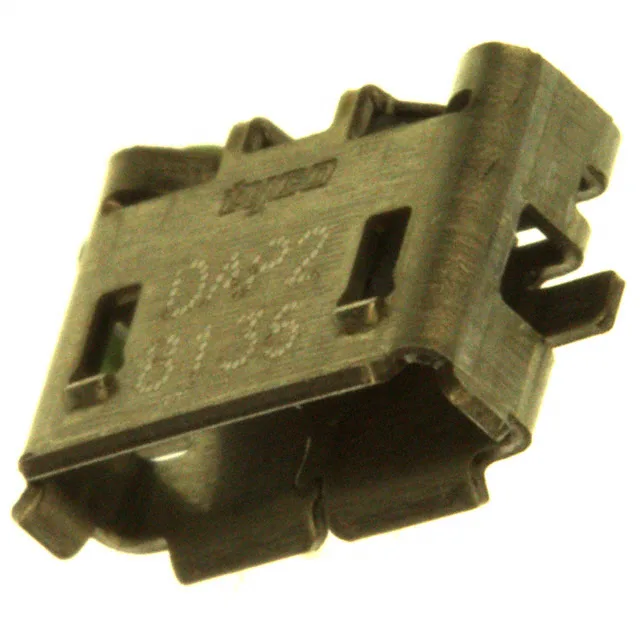
USB 2.0 Micro AB Receptacle for High-Cycle-Duty Applications
Its defining spec is the 10,000 mating cycle rating, an order of magnitude above a typical USB micro connector, which makes it the choice for applications where the port sees frequent connect/disconnect: field-service tools, programming jigs, or lab equipment. The gold-plated contacts and stainless steel shell resist corrosion through repeated use.
What the 10,000-Cycle Rating Means for the Build
The gold-over-nickel contact finish and the steel/stainless shell together handle the mechanical wear. The solder retention feature adds mechanical hold to the SMT pads.
USB 2.0 Micro AB vs Micro B — the ID Pin Difference
The micro AB receptacle accepts both micro A and micro B plugs, while a micro B receptacle accepts only micro B plugs. The difference is the ID (identification) pin on contact 4: in a micro AB receptacle, the ID pin is left unconnected or grounded to signal the device to act as an OTG (On-The-Go) host when a micro A plug is inserted. The 1981584-1 follows the USB 2.0 specification for this pin assignment. If your design only ever mates with a micro B cable (the common phone-charger plug), a micro B receptacle is cheaper and simpler — but the micro AB gives you the flexibility to also accept a micro A plug for host-mode operation.
Current Rating and Pinout — Which Pin Carries What
The three current ratings — 0.5A, 1A, and 1.8A — map to the five pins of the micro USB connector. Pin 1 (VBUS) carries the 1.8A charging current; pins 2 (D-) and 3 (D+) are the differential data pair rated 0.5A; pin 4 (ID) is typically a sense line at 0.5A; pin 5 (GND) returns the full 1.8A. The 30V rating is the maximum voltage between any two pins, which covers USB charging protocols up to USB PD 3.0 at 20V. For a 5V/1A charge-only application, the connector runs well within its thermal limits — the derating curve starts above 85°C.
SMT Footprint and Board Layout Notes
The right-angle SMT orientation with horizontal mounting means the connector sits flat on the PCB edge. The solder retention feature adds two additional SMT anchor pads on the sides of the shell.
No official cross-reference or second-source part is on record.