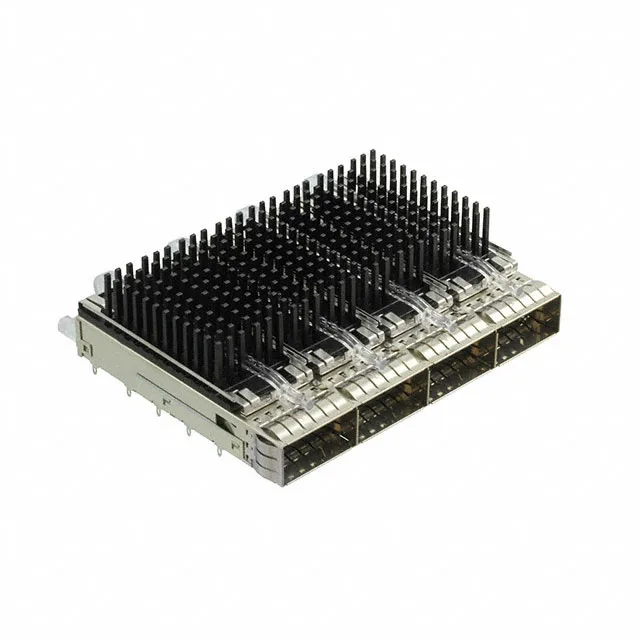
What This Cage Does in the Assembly
It accepts standard QSFP form-factor modules — including 100G QSFP28 transceivers — and provides the mechanical alignment, EMI containment, and thermal management those modules need at the board edge. The press-fit termination eliminates soldering the cage body, which simplifies assembly and rework on the backplane or line card.
Key Features That Drive Selection
The press-fit tails push into plated through-holes without solder, which keeps the assembly lead-free and makes individual cage replacement possible if a port is damaged. EMI shielding is built into the cage body, and the integrated light pipe routes the module status LED to the panel face without a separate light-pipe assembly.
Thermal Performance and the Heat Sink
The heat sink is integrated into the cage — it sits on top of the ganged 1 x 4 housing and draws heat from the transceiver modules through the cage top. The thermal path is designed for the airflow direction typical in switch and router chassis; the fin orientation and surface area match the module's power dissipation envelope for 100G applications. For a specific thermal resistance figure or airflow requirement, the product drawing gives the detailed interface dimensions and recommended airflow.
Press-Fit Mounting and Board Layout
The press-fit termination requires a controlled hole size and PCB thickness to achieve the specified retention force without damaging the plated barrel. The base product number 2170747 leads to the application-specific footprint drawing that lists the hole pattern, recommended PCB thickness, and press-fit insertion tooling.