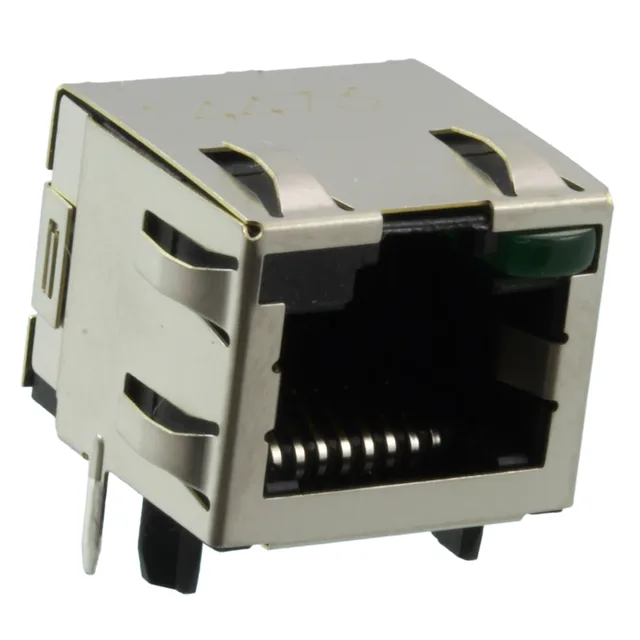
It belongs to the 406549 series of Ethernet jacks, designed for through-hole PCB mounting. The jack integrates a green LED for port status indication and a board guide feature to simplify alignment during assembly. Its Cat5 rating means it is specified for 100 MHz signal performance, supporting 100BASE-TX and 1000BASE-T Ethernet links. The shielded construction with EMI fingers provides conducted and radiated noise suppression, making it suitable for industrial control panels, network switches, routers, and any equipment enclosure where electromagnetic interference is a concern.
The 8P8C contact arrangement is the standard 8-position, 8-contact interface for Ethernet — every pin is wired, so it handles 1000BASE-T without dropping pairs. The tab-up orientation is the typical layout for PCB edge mounting; the latch tab faces upward, matching standard panel cutouts and cable plug insertion.
The shielded construction with EMI fingers is the key differentiator here. The metal shell and integrated grounding fingers provide a low-impedance path from the cable shield to the PCB ground plane, which keeps common-mode noise from coupling into the signal pairs. For a Cat5-rated jack operating at 100 MHz, this shielding is what preserves the return loss and near-end crosstalk (NEXT) margins specified in the TIA/EIA-568 standard. Without it, radiated emissions from the cable can couple into adjacent ports or sensitive circuitry on the board.
This is an active, in-production TE Connectivity part. The tray packaging (per) is standard for through-hole jacks and is suitable for both hand-loading and wave-solder machine feeders.