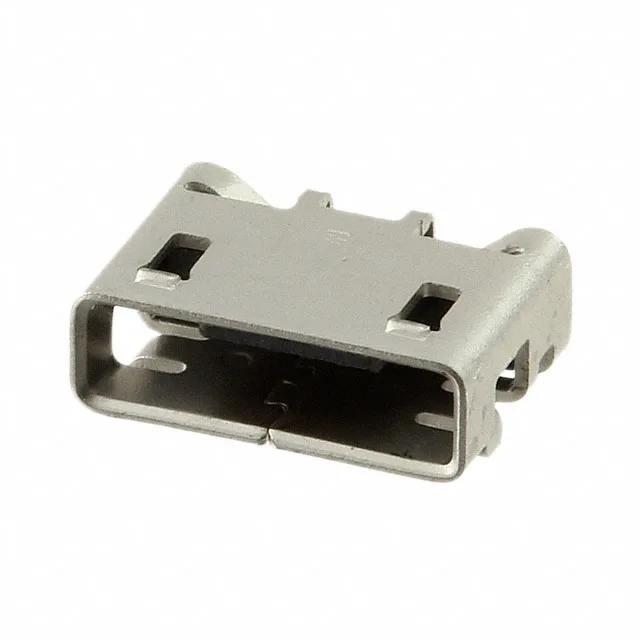
It carries 5 contacts in the standard micro USB layout, supporting USB 2.0 data rates (480 Mbps) and the On-The-Go (OTG) host/device negotiation that the micro AB form factor enables.
Gold plating on the contacts means the mating interface resists corrosion and maintains a stable connection across the several thousand insertion cycles typical of a portable device port. The stainless steel shell provides the mechanical durability and EMI shielding the USB specification requires, with better corrosion resistance than a nickel-plated brass shell in humid environments.
This receptacle is terminated by solder to the PCB — surface-mount pads for the signal contacts and through-hole anchor posts for mechanical retention. The Pick and Place feature indicates the top surface is flat and vacuum-compatible for automated assembly, and the Tape & Reel packaging feeds directly into a standard SMT line. The gray insulation colour is the standard indicator for a micro AB receptacle, distinguishing it from the black micro B.
USB 2.0 vs USB 3.0 — What the Spec Says
The specification field lists USB 2.0, not USB 3.0. A USB 3.0 micro AB connector requires 10 contacts (the standard 5 plus 5 for the SuperSpeed differential pairs) and a different internal contact arrangement. This 5-contact, USB 2.0-rated part will physically mate with a USB 3.0 micro B plug, but the SuperSpeed lines will not connect — the link will fall back to USB 2.0 operation. If your design needs USB 3.0 data rates, this is not the correct receptacle.
Micro AB vs Micro B — The Difference
A micro AB receptacle is designed to accept both a micro A plug and a micro B plug, which is required for USB OTG devices that switch between host and peripheral roles. A micro B receptacle accepts only a micro B plug. The physical difference is in the internal keying — the micro AB has a slot that accommodates the A-plug's chamfer. The gray housing colour is the standard identifier for a micro AB receptacle; micro B receptacles are typically black. If your device does not need OTG host capability, a micro B receptacle (fewer sourcing constraints) may be the simpler choice.