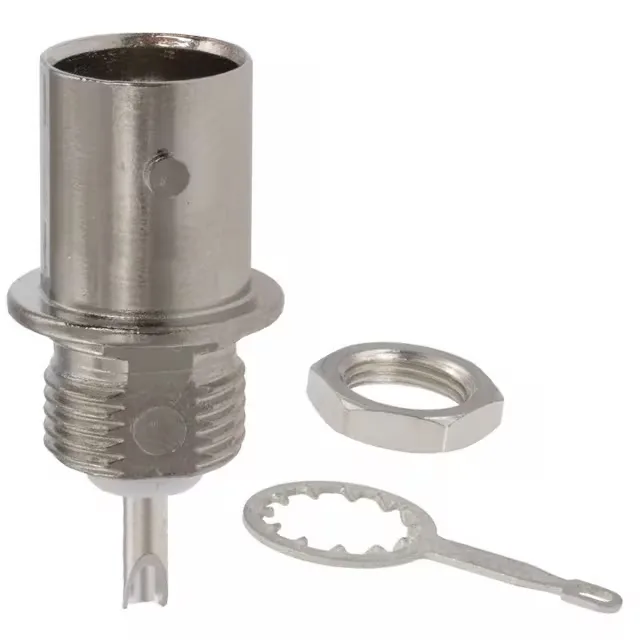
75 Ohm BNC Bulkhead Jack for Video/Telecom — 2 GHz, 500 Cycles
The 221244-1: It is built for video distribution, CCTV, and telecom infrastructure where the 75 Ohm impedance matches standard coaxial cable for baseband video and data signals up to 2 GHz. The connector ships as a kit with the lockwasher and nut included — three pieces total — so no separate hardware sourcing is needed for a clean panel install. The zinc die-cast body with nickel finish and PTFE dielectric gives it the mechanical and electrical stability needed for consistent 75 Ohm performance through the rated 2 GHz bandwidth. The bayonet lock fastening provides a quick quarter-turn mate with positive retention — no threads to cross, no torque spec to hit.
Obsolete — Sourced Through Surplus Channel
It is no longer in active factory production. For BOM lines that still specify this exact order code, availability is limited to the surplus and broker distribution channel. No official TE replacement order code is published for this part; any substitution would require a design review of the mating interface and impedance match.
A 50 Ohm BNC will physically mate with this jack, but the impedance mismatch causes a reflection at the junction — visible as ghosting on video or bit errors on data. The 2 GHz bandwidth covers all standard-definition and most high-definition video formats, plus RF carriers up to the lower microwave range. Above 2 GHz the return loss degrades as the PTFE dielectric and silver-plated contact geometry hit their practical limit. Silver plating on the centre contact gives lower surface resistance than gold at RF frequencies, which matters for insertion loss through 2 GHz. The trade-off is that silver tarnishes over time in humid environments — the 500-cycle rating assumes reasonable environmental exposure, not continuous outdoor or washdown duty.
Mounting and Termination — Bulkhead Install with Solder Cup
The shield termination is a solder tag — you solder the cable braid to the tag, then the centre conductor into the solder cup on the contact. It is a straightforward install for a harness builder but requires a soldering iron and heat-shrink over the braid connection. No crimp tool needed, which keeps the tooling cost low for low-volume or field-repair work. The extended insulation feature (listed in the specs) refers to a longer dielectric body than a standard BNC — this provides extra creepage distance between the centre conductor and the panel ground, useful in higher-voltage video distribution where the 500 V rating needs reliable isolation across the bulkhead.