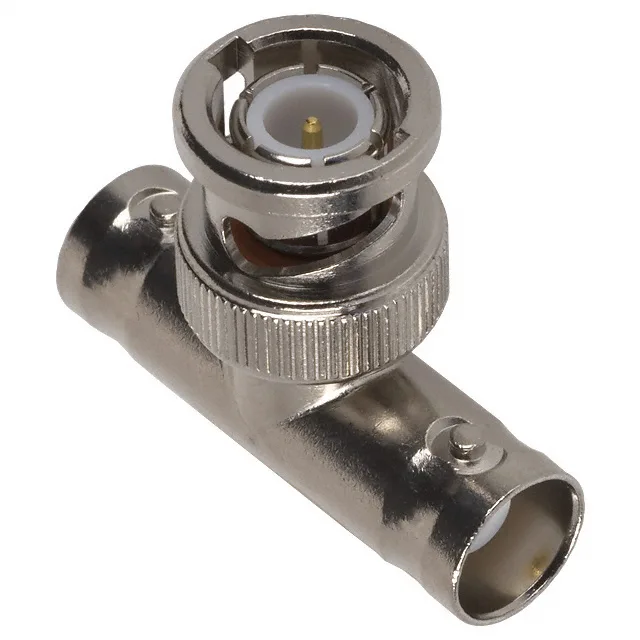
50-Ohm BNC T-Adapter for In-Line Signal Splitting
The TE Connectivity 221543-2 is a BNC-to-BNC T-adapter that converts a single male plug input into two female jack outputs, all within a 50 Ohm impedance path. The T-shape body lets you tee off a coaxial signal line without an extra junction box — common for routing a test signal to two instruments or splitting a reference clock in a lab rack. Center contacts are gold-plated over beryllium copper and brass, keeping contact resistance low through repeated connect-disconnect cycles in field or bench use.
Impedance and Signal Path — 50 Ohm, Not 75
This adapter is built for 50 Ohm systems — the impedance is fixed by the PTFE dielectric and the centre-conductor geometry. It will pass a 75 Ohm signal with degraded return loss and a mismatch at every interface, so stick to 50 Ohm coax (RG-58, RG-213, LMR-195) for the intended performance. The centre gender runs female-to-male through the adapter: the male pin on the plug end connects to the female sockets on the two jack ends, so the signal path stays continuous without gender changers.
Build and Materials — Brass Body, Gold Contacts, PTFE Dielectric
Inside, the PTFE dielectric holds the centre conductor in place and maintains the 50 Ohm characteristic impedance across the operating band. Centre contacts are beryllium copper (plug pin) and brass (jack sockets), both gold-plated. Gold on the mating surfaces handles repeated bayonet engagements without oxidation buildup — important for test equipment that sees daily reconnections.
Mounting and Mechanical — Free Hanging, Bayonet Lock Both Ends
This is a free-hanging (in-line) adapter with no panel-mount flange or PCB footprint — it floats in the cable run. Both the plug and the two jack ends use bayonet-style locking: a quarter-turn engages the coupling nut, and the slot-and-pin interface holds the pair together against vibration and cable tug. The T-shape means the two jack ports sit 90° off the main axis, so the adapter forms a Y in the cable path; plan for the branch to clear adjacent connectors in a dense panel layout.