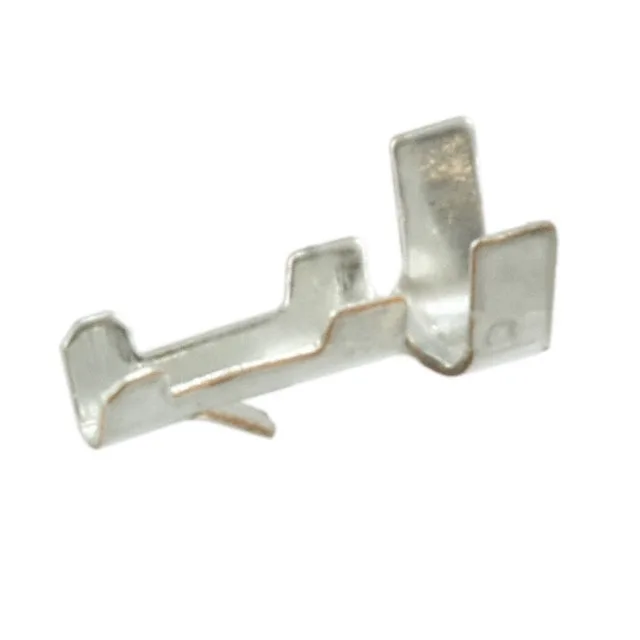
Through-Board Locking Terminal for 22-26 AWG
The TE Connectivity 3-640401-1 is a through-board locking terminal from the Mini Amp-In series, designed to terminate 22-26 AWG wire directly into a PCB. The terminal locks into a 0.055" (1.40mm) plated through-hole, providing a solderless mechanical and electrical connection that holds the wire perpendicular to the board. The tin-plated phosphor bronze contact suits applications where the connection is made once and sees minimal reconnection cycles — think appliance control boards, HVAC modules, or any wire-to-board junction where the harness is assembled to the PCB in production and stays there.
Wire Fit and Board Footprint
The terminal accepts wire with an insulation diameter from 0.040" to 0.100" (1.02mm to 2.54mm), covering most standard 22-26 AWG PVC and thin-wall insulations. The 0.055" (1.40mm) hole diameter is the dimension the PCB fab needs for the drill file — the locking barbs on the terminal body engage the plated barrel of the hole for retention. If your board uses a different hole size, the locking feature won't hold; verify the finished hole diameter matches before committing the layout.
The base product number 640401 covers the series; the 3- prefix indicates the specific reel and packaging variant.
Comparison with 3-640108-1
The closest sibling in the Mini Amp-In line is the 3-640108-1, which also handles 22-26 AWG wire with the same 0.055" (1.40mm) hole diameter and tin-plated phosphor bronze contact. The difference is overall length: the 3-640401-1 measures 0.260" (6.60mm) versus 0.250" (6.35mm) for the 3-640108-1. That 0.010" (0.25mm) delta matters if your board stack-up or component clearance on the opposite side is tight — the longer terminal protrudes further past the solder side. For most builds either works; pick the one that clears your keep-out zone.
This terminal is designed to mate with TE Mini Amp-In receptacle housings — the locking barbs on the terminal body engage the housing cavity latch. The through-board locking feature means the terminal is pressed into the PCB first, then the wire is inserted and the housing is mated over the terminal. No separate crimp operation; the wire is stripped, inserted into the terminal barrel, and the terminal is pressed into the board hole. The insulation diameter range (0.040" to 0.100") determines whether the wire jacket seats fully inside the barrel — strip length is typically the barrel depth, which is not specified in the listing but follows the standard TE application tooling setup for this series.