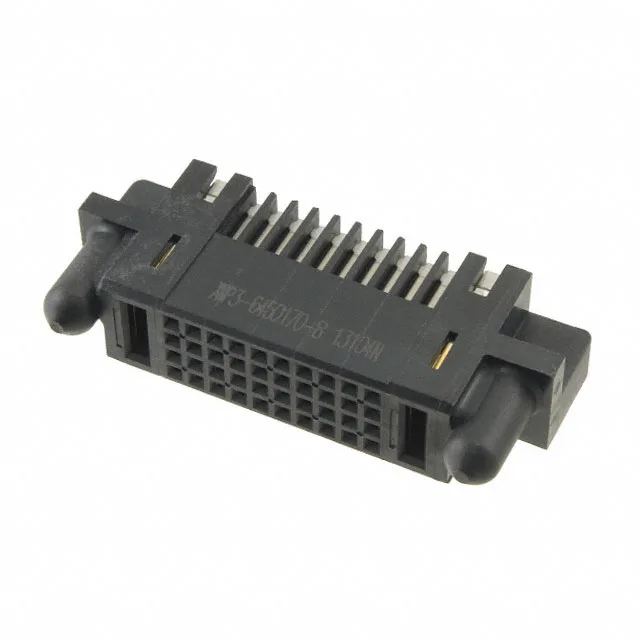
42-Position Power/Signal Hybrid Receptacle for Board-Edge Power Distribution
The TE Connectivity 3-6450170-8 is a 42-position receptacle from the MULTI-BEAM XL series, designed as a hybrid interconnect carrying both power and signal on a single connector body. It uses a 40 signal, 2 power contact layout on a 0.100" (2.54mm) pitch, arranged in 4 rows. The connector mounts to the board edge in a right-angle orientation, soldering through-hole for mechanical strength. It is a receptacle that accepts both female sockets for signal and blade sockets for the power contacts, making it a common choice for power supply units, server backplanes, and industrial power distribution where a single connector handles the main DC rail and control signals.
What the Ratings Mean for the Fit
The 0.100" pitch is the standard for this class of power/signal hybrid connector, giving enough creepage for the power contacts without forcing an oversized board footprint. The 30.0µin gold plating on the contacts is a heavy-duty finish — it handles repeated mating cycles and resists corrosion in environments where the connector is field-serviced, such as in telecom rectifiers or industrial drives. The board lock and guide pin features are not optional: the guide pin aligns the connector during blind mating in a chassis, and the board lock holds the part in place during wave solder, preventing skew that would misalign the power blades. The UL94 V-0 housing confirms the connector is rated for equipment inside an enclosure where flame spread must be contained.
Mounting and Termination
This is a board edge, through-hole, right-angle mount receptacle. The solder termination is standard for through-hole assembly — the power blades and signal pins are soldered into plated through-holes on the PCB. The right-angle orientation means the connector body sits parallel to the board surface, with the mating face at the board edge, which is typical for power supply modules that slide into a chassis backplane. The guide pin ensures the connector aligns with the mating header before the contacts engage, reducing the risk of stubbing the power blades.