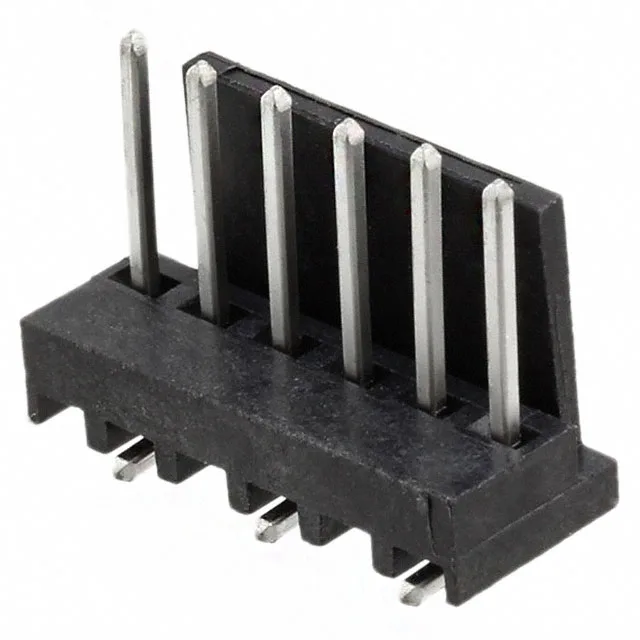
The single-wall shroud polarizes the mating face but leaves the top of the pins exposed — enough guidance for a technician to seat the receptacle by feel, but less physical protection than a full shroud. In a panel where the header sees occasional cable dress changes, that's fine; in a high-vibration harness, the latch does the retention work. Tin-plated mating surface and tin-plated posts. At the current rating that varies by wire gauge, tin is adequate for moderate mating cycles — budget a few dozen mates before the contact finish wears. For a production assembly that mates once and stays, tin is the economical call.
Surface-mount assembly — what the SMD termination means for the board
The SMD termination places the header flat on the PCB pads — no through-hole stubs, no secondary wave-solder step. The insulation height of 0.347" (8.81 mm) sets the z-height budget above the board surface; the mating pin length of 0.290" (7.37 mm) is the engagement depth for the receptacle contact. Because the header is surface-mount, the board-side footprint is a row of six solder pads at 2.54 mm pitch. No plated through-holes to route around — the routing density under the header is better than a through-hole equivalent, but the SMD joints carry the full mechanical load of the cable strain. A board lock would help here; this part does not have one (shows no board lock feature), so the solder fillet alone resists peel forces from the cable.
Active production — sourcing the 3-647106-6 today
The part is RoHS compliant.
Mating with MTA-100 receptacles — what fits
This header mates with standard MTA-100 IDC and crimp receptacles (: Board to Cable/Wire). The 0.100" pitch, 6-position single-row layout, and square 0.025" pins are the MTA-100 interface.